
Healthcare Revenue Cycle Compliance
Billing/RCM

Common Compliance Risks in OB/GYN Medical Billing and How to Address Them

Written by Noah Smith for BillingFreedom

The article will help healthcare professionals identify common compliance risks that can arise in OB-GYN medical billing and understand practical approaches for addressing those risks through accurate documentation, coding, claim review, internal audits, and consistent billing workflows.

OB/GYN billing can get complicated quickly. During the same week, a practice may bill for preventive visits, ultrasounds, office procedures, prenatal care, surgery, delivery services, postpartum visits, and treatment for unrelated gynecologic conditions. Those services do not always follow the same documentation, coding, or payer rules. That leaves plenty of room for small mistakes to slip into the billing process.

Sometimes the problem is obvious. A claim is rejected because the subscriber number is wrong or a required field is missing. Other problems are harder to notice. A payer may process a claim even though the documentation is weak, a modifier has been used inconsistently, or staff are following an outdated billing process.

One paid claim does not necessarily tell a practice that everything behind the claim was handled correctly. A better way to think about compliance is to look at the entire path a claim takes:

  • Patient information has to be accurate.
  • Coverage needs to be checked.
  • The provider's note has to support the service.
  • Coding needs to match the record, and payer requirements have to be addressed before the claim goes out.

When one part of that chain breaks down repeatedly, the problem can spread across dozens of claims before anyone recognizes the pattern.

Where OB/GYN Billing Problems Usually Start

Many compliance issues begin before a coder ever looks at the chart. Consider a returning patient whose insurance changed since her last appointment. If the old plan is still listed in the system, the claim may be sent to the wrong payer. By the time the rejection comes back, staff may need to update the account, verify benefits again, rebill the service, and make sure a filing deadline has not been missed.

Authorization problems can develop in much the same way. A service may have been appropriate and clearly documented, yet the claim can still run into trouble if the payer required prior authorization and nobody confirmed it.

Then there is the medical record itself. A provider may remember exactly what was discussed or performed during a visit, but the billing team can only rely on what appears in the documentation. If the note does not clearly support the service being reported, defending the claim later becomes much more difficult.

The Centers for Medicare & Medicaid Services (CMS) provides guidance on electronic healthcare claims and the information needed for claims processing. The larger point for a practice is simple: compliance starts long before a denial or payer review arrives.

Documentation and Coding Need to Tell the Same Story

Documentation and coding are often discussed as separate tasks. In actual billing, they are difficult to separate. The code on the claim is supposed to represent what happened during the encounter. The medical record is what supports that representation.

Problems begin when the two tell different stories.

A common OB/GYN situation is a preventive visit in which the patient also brings up a new medical concern. Additional evaluation may take place during the same encounter. Whether separate reporting is appropriate depends on the services performed, the documentation, coding rules, and the payer's requirements. Similar questions come up with procedures, diagnostic testing, postoperative care, maternity services, and modifier use.

A diagnosis code may be valid in general but still fail to match what the provider actually documented. A procedure code may describe a service correctly but lack enough support in the chart. A modifier can also create problems when staff use it routinely instead of deciding whether the circumstances of that particular encounter justify it. These are not always dramatic errors. That is part of the problem.

When the same documentation habit or coding shortcut is repeated week after week, an isolated weakness can turn into a larger compliance concern.

Periodic chart-to-claim reviews can help uncover those patterns. Instead of asking only whether the claim was paid, the reviewer looks at whether the claim accurately reflects the record and whether the documentation is strong enough to support what was billed.

Some Claim Errors Have Nothing to Do with Complex Coding

Not every denied or rejected claim involves a difficult coding question. Sometimes the problem is a wrong date, an outdated insurance record, missing provider information, an incorrect subscriber ID, or a claim field that was left incomplete. These errors may sound minor, but they still consume staff time and slow down payment.

Electronic claims generally pass through automated edits during processing. Certain missing or inconsistent details can cause the claim to stop before it gets very far.

A short review before submission can catch many of those problems. Staff may want to verify:

  1. Patient and subscriber information.
  2. Current insurance coverage and coordination of benefits.
  3. Provider and practice identifiers.
  4. Diagnosis codes, procedure codes, and modifiers.
  5. Documentation supporting the billed service.
  6. Required authorization or referral information.
  7. Payer-specific claim requirements and missing fields.

The review does not have to turn into a lengthy approval process for every claim. What matters is that the practice has a reliable way to catch repeatable errors before the payer does.

Eligibility Deserves More Attention in OB/GYN Billing

Insurance information can change during the course of care, and OB/GYN practices are especially likely to encounter that issue because many patients receive services over an extended period.

Pregnancy is an obvious example. A patient may have one insurance plan early in the pregnancy and another later. Employment can change. A spouse's coverage can change. Coordination of benefits may need to be updated. Authorization rules may also be different under the new plan. If staff rely on an eligibility check performed months earlier, the billing team may not find out about the change until a claim is denied.

Eligibility problems can affect more than reimbursement. They may also result in the wrong amount being assigned to the patient or create confusion about who is financially responsible for the service.

Checking coverage at appropriate points throughout treatment gives staff a chance to address those issues before the claim has already gone through the billing cycle. It also makes financial conversations with patients more accurate.

A Denial May Be Pointing to a Workflow Problem

Correcting a denied claim is necessary. Correcting the same type of denial twenty times should raise a different question - Why does it keep happening?

Suppose claims for a particular procedure regularly come back because information is missing. Billing staff can add the information and resubmit each claim, but that does not explain why the original claims were incomplete.

Maybe the registration team is not collecting something the payer requires. Perhaps the authorization information exists but is not being transferred correctly. It could also be that staff misunderstood a payer policy. The denial itself is only the visible part of the problem.

This is why useful denial management goes beyond counting how many claims were denied. Practices can look at which reasons occur most often, which payers are involved, whether one service keeps appearing, and where in the workflow the original error began.

That kind of review can reveal patterns that would otherwise remain hidden. The CMS Medical Review and Education resources also discuss claims analysis and medical record review in the context of identifying improper billing and documentation issues. For an OB/GYN practice, denial data can serve as a practical warning system. It shows where the revenue cycle is struggling, not just where payment was delayed.

Internal Audits Can Be Small and Still Be Useful

An internal audit does not have to involve hundreds of charts. A practice can learn a great deal from a carefully chosen sample.

Maybe one modifier has been causing questions. Perhaps a particular payer has denied an unusually high number of claims. There may be concerns about preventive visits, maternity billing, surgery, medical necessity documentation, or another service that carries more risk. Those claims can be reviewed against the medical record.

The reviewer may find that everything was handled appropriately. If not, the next step is to determine whether the problem was isolated or whether it reflects a larger habit. That distinction matters. One coding mistake made on a single claim may require a simple correction. Finding the same mistake across several providers or multiple dates of service suggests that the practice may need education, a workflow change, or closer monitoring. The audit should not end when the error is identified.

If a change is made, the practice needs some way to determine whether it worked. Reviewing another sample later can show whether the same problem is still appearing. Without follow-up, the practice has documented a problem but has not necessarily solved it.

Compliance Works Better When It Is Part of Routine Operations

A compliance process does not need to be complicated to be useful. In many practices, consistency matters more than creating a large set of policies that nobody uses. Staff should know how registration is handled, when eligibility is checked, how authorization information is recorded, how claims are reviewed, what happens when a denial arrives, and who is responsible for following up on recurring problems.

Those processes should not exist only in one employee's memory. Training matters for the same reason. Payer policies change. Coding guidance changes. Internal workflows change. New employees arrive, and experienced employees sometimes continue using a process that made sense under an older rule.

Regular education gives the practice a chance to catch those gaps.

Billing data can also help determine where training is needed. If eligibility denials suddenly increase, the first response should not necessarily be a general coding seminar. The practice may need to look at registration and verification instead. If several claims involving the same modifier are being questioned, a focused review of those encounters is probably more useful than retraining the entire staff on every coding topic. Compliance becomes easier to manage when the response matches the actual problem.

Documentation Reviews Should Include the Claim

A chart can look complete on its own while the corresponding claim still contains a problem.

The opposite is also possible. A claim may appear technically correct until someone compares it with the medical record.

Looking at both together usually provides a clearer picture. This is particularly important for services where the circumstances of the encounter affect billing. Preventive care, problem-oriented visits, procedures, maternity care, and postoperative services can all raise questions that cannot be answered by looking at a code alone.

The reviewer needs to understand what actually happened during the visit, what the provider documented, and how that information was translated into the claim.

Preparing for Billing Changes Before They Reach the Claims Department

One of the easiest ways for a billing problem to spread is for a rule to change while the practice keeps following the old process. Changes may affect coding, documentation, payer policies, reimbursement, or the way certain services are reported.

The first sign should not have to be a wave of denials.

When a significant change is announced, the practice can identify which services will be affected and who needs to know about it. Providers may need different documentation. Billing staff may need revised procedures. Software settings or claim edits may also need to be updated. Testing the new process early is usually easier than correcting a backlog later. This becomes especially important when changes affect maternity services because the care and billing may span several months.

The Bigger Compliance Question

A claim can be paid and still come from a weak process. That is why payment should not be the only measure of whether an OB/GYN billing operation is working well. A better question is whether the practice could explain and support the claim if someone reviewed it later.

  • Was the patient's coverage checked?
  • Does the chart support the service?
  • Does the code match what was documented?
  • Were payer requirements addressed?
  • If a similar problem appeared last month, was anything changed afterward?

Those questions bring compliance into the normal revenue-cycle process instead of treating it as something that matters only during an audit.

Most billing problems do not begin as major compliance failures. They usually start much smaller: an insurance detail that was not updated, documentation that was a little too vague, a modifier applied out of habit, or a denial that was corrected without asking why it happened.

The risk grows when the same issue becomes routine.

Finding those patterns early is what gives a practice the best chance to correct them before they affect more claims, more patients, or more revenue.

About the Author Noah Smith

This article is written by Noah Smith on behalf of BillingFreedom. Noah is a medical biller, SEO and Content Outreach Specialist.

Additional Resources

Copyright © 2026 American Institute of Healthcare Compliance All Rights Reserved

Read More
Healthcare Revenue Cycle Compliance
Billing/RCM

Mitigating Compliance Risks in Genetic Testing Billing and Medical Necessity Claims

Written by: Ricky Bell 

Having spent a decade advising clinical laboratories and health systems on revenue cycle management, I can tell you that molecular diagnostics remains one of the most volatile operational areas in healthcare. Federal spending on genetic testing under Medicare Part B now sits above $3.6 billion every year. That rapid financial growth brought aggressive oversight from the U.S. Department of Health and Human Services Office of Inspector General (HHS-OIG) and the Department of Justice.

In the complex arena of medical billing, molecular diagnostic testing sits right in the crosshairs of federal auditors. Regulators no longer rely on random sampling. Instead, they deploy advanced data analytics to flag billing anomalies instantly. For compliance officers and practice managers, ensuring every claim meets strict coverage standards isn't just a recommendation—it is a survival strategy that lab executives cannot afford to sleep on. Rules change overnight. When billing protocols lack internal controls, financial penalties and False Claims Act liability follow quickly behind.


Where Labs Usually Get Burned

When reviewing Federal enforcement actions, one may find specific aspects of operations that lead to regulatory setbacks, including clawbacks and fines. For example, OIG has on multiple occasions published fraud alerts with the primary goal of targeting genetic testing practices and has pointed out that claims that result in financial penalties most often stem from major failure of the system's processes rather than from honest error.

Common High-Risk Testing Behaviors:

  • High-Risk Testing Behaviors.
  • Billing unbundled molecular CPT codes.
  • Bill a panel without a chart proof.
  • No signature by the doctor on the order.

Use of non-compliant lead-generation practices that may violate healthcare marketing regulations. Incorrect use of unlisted codes that relate to the genome.

Examine billing of multi-gene panels for cancer. Legal consequences come immediately when multi-gene hereditary cancer or pharmacogenomic panels are billed without showing the medical necessity of each individual gene target. Paying entities do not generally accept that a broadly screening panel is a medical necessity simply because a patient has a family history of disease. In addition, laboratory-marketing relationship set-ups frequently breach the Eliminating Kickbacks in Recovery Act (EKRA) and the Anti-Kickback Statute. When labs pay for marketing services in proportion to volume or claim value, they open themselves up to the possibility of being investigated by the Department of Justice, a common compliance issue that many lab managers face.

Navigating Medical Necessity and Coverage Controls

Defining medical necessity in genetics testing is really about finding a middle ground between clinical utility and coverage criteria determined by payers. An example is when a physician thinks a 50-gene panel is the ideal choice for giving the right diagnosis. Still, if the local coverage policy (LCD) lists just five genes as the only ones that are covered and the patient's condition is consistent with only these genes, then the doctor will be referring to the patient for the other testing that the insurance is not covering.

Maintaining billing compliance, organizations must master the requirements set by the Molecular Diagnostic Services (MolDX) program and commercial utilization management policies. Commercial payers and state Medicaid programs frequently diverge on prior authorization rules, creating administrative friction for billing staff. Truth is, what works for Medicare might fail completely with a commercial plan.

Key Operational Checks for Coverage:

  • Review local coverage rules monthly.
  • Get prior approval before testing.
  • Document clinical rationale in charts.
  • Verify specific CPT code coverage.
  • Check doctor order signatures daily.

A pre-test verification procedure is a compulsory setup. If a lab gets referrals from community physicians outside, it will be wrong to assume that the requesting provider already wrote medical necessity notes in their EMR. The lab on its own has to verify that clinical records back up the selected test panel before carrying out the test and presenting the charge. Not checking the chart papers exposes the lab to risks during an after-payment review of billing practices. So, you don't ever want to end up having that as your big error.

How to Build an Audit Framework That Works

To prevent improper payments, progressive health systems are moving away from passive retro-audits. Implementing an active Genetic Testing Stewardship Program (GTSP) provides a proven operational blueprint. For example, Nemours Children’s Health successfully curtailed unnecessary genetic testing orders by placing certified genetic counselors directly into the ordering workflow and embedding hard-stops in their Electronic Health Record (EHR) systems.

A solid internal audit framework evaluates claims both before submission and after payment. Health systems must establish routine internal controls that evaluate coding accuracy, physician intent, and documentation completeness.

Essential Audit Program Controls:

  • Add decision support in EHR.
  • Audit high-risk codes monthly.
  • Use genetic counselors as gatekeepers.
  • Track payer denial codes weekly.
  • Check fair market value rates.

Concurrently, compliance teams should conduct random quarterly audits on claims utilizing unlisted CPT® codes (such as CPT® 81479). Unlisted codes attract automatic payer scrutiny. If your team uses unlisted codes to bypass prior authorization or LCD restrictions, auditors will flag those claims for recoupment. Training billing personnel to double-check local coverage policies ensures that claims align precisely with current billing guidelines.

Real Exposure Under Federal Statutes

The risks linked to statutory non-compliance are not just limited to denial of claims.  Compliance risks related to molecular diagnostic services can have far-reaching consequences, including the imposition of heavy statutory penalties under the False Claims Act, Stark Law, and EKRA. Pursuant to the False Claims Act, if one submits claims for tests that do not have a documented medical necessity, this may result in the payment of triple damages plus the imposition of compulsory civil money penalties per claim.

Labs need to figure out as well, how they relate their working relationships, if any, with ordering physicians, and clinical consultants. It is a federal crime under anti-kickback laws to distribute free point-of-care testing devices, offer lavish consulting arrangements, or to provide generous collection fees to ordering clinics. Basically speaking, financial arrangements between you and a referrer should only be as much as the Fair Market Value (FMV) of the service actually done. Besides, having clear and complete documentation of FMV determinations and legal opinions is another defense measure that every lab board should definitely work on.

About the Author

Ricky Bell (https://www.dastifysolutions.com/team/rickybell/) is Head of Operations at Dastify Solutions, where he oversees healthcare operations, revenue cycle management, and compliance initiatives for physician practices, clinical laboratories, and healthcare organizations across the United States. With extensive experience in medical billing, coding compliance, denial management, and revenue cycle optimization, he helps healthcare providers strengthen operational efficiency while maintaining regulatory compliance.

Resources

  1. U.S. Department of Health and Human Services Office of Inspector General (HHS-OIG): Fraud Alert: Genetic Testing Scam.
    https://oig.hhs.gov/fraud/consumer-alerts/fraud-alert-genetic-testing-scam/
  2. American Health Law Association (AHLA): Fraud and Abuse Issues in Diagnostic and Molecular Testing.
    https://www.healthlawyers.org
  3. Centers for Medicare & Medicaid Services (CMS): MolDX: Molecular Diagnostic Tests (LCD L35025).
    https://www.cms.gov/medicare-coverage-database/view/lcd.aspx?lcdid=35025
  4. Kaiser Family Foundation (KFF): Coverage of Breast Cancer Screening and Prevention Services.
    https://www.kff.org/womens-health-policy/coverage-of-breast-cancer-screening-and-prevention-services/
  5. National Center for Biotechnology Information (NCBI / PMC): The Genetic Testing Stewardship Program: A Bridge to Precision Diagnostics for the Non-genetics Medical Provider.
    https://pmc.ncbi.nlm.nih.gov/articles/PMC9124555/

Copyright © 2026 American Institute of Healthcare Compliance All Rights Reserved
Read More
Healthcare Revenue Cycle Compliance
Billing/RCM

Healthcare Revenue Cycle Compliance

Common Risks and How Practices Can Address Them 

Written by: Zara Ahmad 

A revenue cycle rarely breaks because of one dramatic mistake. More often, the problem begins with something ordinary: an insurance card was updated but the old plan stayed in the system, a provider’s note lacked enough detail for coding, or a denied claim was resubmitted before anyone checked the first one.

Compliance is not limited to the billing office. It starts when patient information is collected and continues through documentation, coding, claim submission, payment posting, denials, and follow-up.

Where Compliance Risks Can Enter the Revenue Cycle

Consider a routine office visit. The front desk enters the patient’s demographic and insurance information. If the member number is wrong, or the payer on file is outdated, the claim may already be inaccurate.

The next risk may appear in the medical record. A provider knows what happened during the visit, but a coder can only rely on what is documented. If a note is vague, staff should not fill in missing details from habit or assumption.

Charge capture creates another point of exposure. A service can be missed, entered twice, or attached to the wrong date. Later, a biller may resend a denied claim without confirming whether the original is still processing. Payment posting and accounts receivable follow-up can create problems too, especially when adjustments or corrections receive little review.

Common Revenue Cycle Compliance Risks

One familiar risk is a mismatch between the medical record and the claim. The service billed should be supported by the documentation. CMS guidance for Medicare makes documentation part of determining whether applicable coverage, coding, billing, and payment requirements are supported.

Incomplete documentation is often less obvious. A note may show that care occurred but still omit information needed to support a code, modifier, or service level. If that happens regularly, the issue is no longer just one troublesome claim.

Administrative mistakes matter as well. Incorrect patient details, insurance information, provider identifiers, and dates of service can cause denials and repeated corrections. Duplicate claims are another example. When payment is delayed, resubmitting the same claim may feel harmless, but claims-processing rules include duplicate edits.

Corrections need a consistent approach – contingent upon the payer and circumstances, the right step may be a corrected claim, replacement claim, appeal, or another defined process.

Why Documentation and Coding Accuracy Matter

Documentation, coding, and billing are different jobs, but they should describe the same encounter.

Suppose a coder returns the same type of note to the same provider several times each month because one detail is routinely missing. Correcting each claim solves the immediate problem, not the workflow problem.

A short, focused discussion with the provider may be more useful than another round of individual corrections. The aim is simply to make sure the record clearly reflects the service provided and gives coding staff the information they need.

Using Internal Audits to Identify Compliance Risks

Internal audits are most useful when they answer a specific question.

A manager might sample claims involving a frequently used modifier, one provider, a service with rising denials, or a payer that has generated repeated corrections. The review can compare claims with medical records, check key fields, examine adjustments, and see whether staff followed internal procedures.

Patterns often tell the real story. Several eligibility denials traced to the same registration step suggest a front-end workflow problem. Repeated coding questions may point to training or documentation habits instead.

An audit should lead somewhere. Someone needs to own the follow-up, record what changed, and later check whether the change helped.

Building a Stronger Compliance Culture

Compliance works better when people see how their own work affects the claim. Front-office staff influence patient and insurance information. Providers influence documentation. Coders and billers influence what reaches the payer. Managers decide whether recurring problems are investigated or simply worked around.

OIG’s General Compliance Program Guidance discusses written policies, education, communication, auditing and monitoring, and corrective action as parts of a compliance program. In everyday practice, those ideas are more useful when connected to real problems rather than treated as an annual checklist.

Training should follow the same principle. If an audit finds repeated modifier errors, train on that issue. If registration mistakes are driving denials, review that workflow with the people who perform it.

Practical Steps Healthcare Practices Can Take

  1. Review a representative sample of claims regularly.
  2. Compare billed codes with the supporting medical record.
  3. Track denials and claim corrections by reason.
  4. Review write-offs, refunds, adjustments, and claim changes for consistency.
  5. Use recurring errors to guide staff and provider education.
  6. Keep billing and compliance procedures current and easy to find.
  7. Document corrective actions and check whether they worked.
  8. Follow relevant CMS, OIG, and other authoritative guidance as requirements change.

Keeping Compliance Part of Everyday Work

No revenue cycle will be completely free of errors. What matters is what happens after a mistake is found. Comply with overpayment rules. Submit appropriate claims adjustments, credit balance reports, or self-reported refunds directly to your assigned Medicare contractor.

Investigate. Correct the affected account, but do not stop there. Ask where the error entered the process, why it was not caught earlier, and whether the same thing is happening elsewhere. That turns compliance from a periodic exercise into part of ordinary revenue cycle work. Over time, it can reduce avoidable rework, support more accurate billing, and leave a practice better prepared when claims are reviewed.

About the Author

Zara Ahmad is a healthcare industry professional and Marketing Team Lead at MedsIT Nexus, with a focus on healthcare revenue cycle management, healthcare operations, and industry education. Her work involves developing educational resources on healthcare administration, revenue cycle processes, and operational challenges affecting healthcare organizations.

Resources – obtain training in conducting internal audits and investigations from the American Institute of Healthcare Compliance, a Licensing/Certification partner w/CMS.

Copyright © 2026 American Institute of Healthcare Compliance All Rights Reserved

Read More
Healthcare Revenue Cycle Compliance
Billing/RCM

HCC Coding in 2026

Navigating Risk Adjustment in a Changing Healthcare Landscape 

Written by: Joy Rose, MSA, RHIA, CCS, CHA, CHPS 

In 2026, Hierarchical Condition Category (HCC) coding continues to evolve as a central pillar of risk adjustment in value-based care. Initially introduced by the Centers for Medicare & Medicaid Services (CMS) to project healthcare costs and determine payments for Medicare Advantage (MA) plans, HCC coding has become a strategic necessity across multiple payers and care settings.

Medicare Advantage Organizations (MAOs) are paid at a higher rate for patients who have conditions with greater levels of severity and multiple conditions, as their RAF scores and anticipated costs of care will be higher.

Key 2026 Medicare Advantage (MA) Cost Reporting Requirements

CMS requires Medicare-certified acute care hospitals reimbursed under the IPPS (inpatient prospective payment system) to report median negotiated payment rates from Medicare Advantage (MA) plans by MS-DRG on their annual cost reports for cost reporting periods ending on or after January 1, 2026.

This mandate aims to collect market-based data to set future inpatient prospective payment system (IPPS) relative weights.

  • Data will be used to set future MS-DRG weights likely by Fiscal Year 2029.
  • This requirement adds significant complexity to an already error-ridden annual Cost Report process.

Providers must ensure the accurate reporting of MA negotiated rates to avoid potential audit findings, as this data will influence future payment setting.

New in 2026 - Full transition to V28 Model has occurred

One of the biggest updates in 2026 is the full implementation of the CMS-HCC V28 model, which was first introduced in 2023. This model includes significant changes:

  • More clinically relevant or accurate groupings, especially for chronic conditions like diabetes and congestive heart failure.
  • Expanded but refined HCC categories: V28 increases the number of HCC categories from 86 to 115, creating more granular groupings while reducing additive combinations.
  • Renumbering and changing HCC categories.
  • Removal of some condition codes that were found to be less predictive of future healthcare costs.
  • Reduction in the number of ICD-10-CM codes from 9,797 to 7,770 (approximately 2294 codes deleted and 268 codes added)
  • More accurate clinical data and the use of data-drive results with the use of 2018 ICD-10-CM codes and 2019 payment information.

Healthcare providers must now re-map workflows for diagnosis coding processes and re-educate coding staff to ensure accurate code assignment based on the documentation provided by clinicians.

Greater Emphasis on Documentation Integrity - With more sophisticated audits by CMS and private payers, clinical documentation improvement (CDI) remains a top priority. Inaccurate or unsupported codes now carry steeper compliance risks, and real-time documentation tools are being widely adopted to assist clinicians. Clinicians must be educated and trained about the new model which will require even greater specificity in documentation and code assignment to ensure that the true level of the Medicare Advantage patients’ illness severity is captured and transmitted to CMS for appropriate costs analysis.

AI and NLP Integration - Natural Language Processing (NLP) and artificial intelligence (AI) tools are increasingly embedded in EHR systems to assist in identifying undocumented HCCs and improving capture rates. These tools help flag missed conditions, identify hierarchical overlaps, and ensure that chronic conditions are properly documented and reported annually. AI has its limitations according to a colleague managing denials.

Important Note - The AI tool that is being tested a major Boston medical facility is not intelligent enough to find HCCs, or even ICD-10 codes to ensure a robust denial can be created.  The medical team working with the denials team does not approve the AI findings in about 80% of the AI suggestions.

Key Challenges - Training and education remain critical as coding teams and clinicians adjust to new rules and technology.  In addition, there is coding fatigue from increased workload and regulatory pressure may affect coder accuracy and job satisfaction.

Providers must also balance HCC optimization with ethical standards and compliance, avoiding aggressive or unsupported upcoding practices. It is important for organizations to realize there is increased CMS scrutiny, by flagging providers as high-volume billing outliers or submitting claims with unusually high severity levels.

Opportunities:

  • Risk-adjustment data analytics now allow organizations to benchmark performance and track documentation trends in real time.
  • Proactive condition management enabled by accurate HCC coding allows payers and providers to better target care management and reduce preventable costs.
  • Interoperability and FHIR-based data exchange in 2026 enable smoother sharing of clinical data across systems, improving longitudinal risk tracking.
  • Increased focus on severity of patient diagnosis and claims by CMS

Real World Impact

As CMS moves further into outcome-based models and enhances its oversight of MA payments, the role of HCC coding will only grow in significance. Health systems that invest in robust CDI programs, AI-assisted coding tools, and clinician training will be better positioned to thrive in this value-based future.

Some analysts warn the shift could lower RAF scores 10-20% for providers still relying on V24-era documentation habits, since patients whose only qualifying condition was deleted in V28 effectively disappear from risk registries. Plans with large diabetic populations that previously captured a lot of complication-related detail are seeing the steepest declines, though expanding documentation breadth across different disease families can partly offset this.

Because of the revenue pressure, CMS/OIG have signaled they'll be watching closely for organizations overcompensating with inflated severity coding.

About the Author

Joy Rose, MSA, RHIA, CCS, CHA, CHPS is a member of the American Institute of Healthcare Compliance (AIHC) and serves as a subject matter expert on the AIHC Volunteer Education Committee.

References:

Copyright © 2026 American Institute of Healthcare Compliance All Rights Reserved

Read More
Healthcare Revenue Cycle Compliance
Billing/RCM

What Government Enforcement Can Teach Us About Coding and Reimbursement

Written By: CJ Wolf, MD 

This article presents educational information related to compliant documentation, coding and billing to avoid fraud, waste and abuse in our healthcare system. Dr. Wolf makes his point by presenting a qui tam case related to vascular diagnostic testing.

Medical coding is a critical aspect of accurate reimbursement for a variety of medical services. Many healthcare compliance enforcement actions, especially those brought under the Federal False Claims Act (FCA), stem from allegations of inaccurate coding.

Healthcare compliance professionals can learn a great deal from diving deep into the details of various enforcement actions. As it relates to medical coding, some enforcement actions teach compliance and coding professionals a great deal of how inaccurate coding can lead to significant investigations and multi-million-dollar settlements.

The details behind a recent $37 million settlement between the U.S. government and a medical device company, along with their former distributor, inform coders and compliance professionals about the risks of inaccurate coding related to a common medical condition known as peripheral arterial disease (PAD)1.

PAD in the lower extremities is the result of narrowing or blockage of the arteries carrying blood with oxygen to the legs. A common symptom for patients with PAD is leg pain when walking. This type of pain is frequently referred to as claudication. Physicians use their clinical knowledge, experience and certain tests to diagnosis PAD and its varying degrees of severity.

One of the most common diagnostic tests utilized by physicians to evaluate PAD is the ankle brachial index (ABI). The test can help estimate the severity of the blockage, which is important when planning treatment and management options. Medicare has coverage policies and requirements for tests that can measure blood circulation in situations such as PAD. The critical policy that played a major role in this multi-million-dollar settlement is Medicare’s National Coverage Determination (NCD) 20.14 on plethysmography.  Plethysmography involves the measurement and recording (by one of several methods) of changes in the size of a body part as modified by the circulation of blood in that part.

In addition, the definitions of certain Current Procedural Terminology (CPT®) codes, 93922, 92923, or 93924 must be accurately met to submit these codes on claims to Medicare for reimbursement of these diagnostic tests. The medical codes require that a provider conduct an ABI test plus certain additional testing. In addition, Medicare does not cover noninvasive vascular tests that use photoelectric plethysmography, also known as photoplethysmography (PPG), which uses a light sensor to detect changes in blood volume.

For example, the Medicare NCD classifies the types of technology used for the testing that is covered compared to those not covered. The covered and non-covered procedures from the NCD are listed below:

Covered

  • Segmental Plethysmography
  • Electrical Impedance Plethysmography
  • Ultrasonic Measurement of Blood Flow (Doppler)
  • Oculoplethysmography
  • Strain Gauge Plethysmography

Non-covered (Medicare considers these experimental)

  • Inductance Plethysmography
  • Capacitance Plethysmography
  • Mechanical Oscillometry
  • Photoelectric Plethysmography

Two experts in vascular diagnostic testing filed a qui tam, or whistleblower, lawsuit under the False Claims Act. They alleged the companies were marketing their devices to providers, such as physicians, telling them their testing device could be reimbursed by Medicare even though the procedure used is PPG, which is a non-covered classification as described in Medicare’s NCD. The government intervened in the case and joined in alleging that the medical codes submitted on claims to Medicare were inaccurate, thus the companies caused providers to submit false claims.

According to the legal complaint filed with the courts, the whistleblowers stated that the device manufacturer and their distributor promoted use of their PPG devices as easier, quicker, and less expensive than the use of Doppler technology for diagnosing PAD. They also claimed the companies said Medicare (and other government payers) pay out the same amount for any service that fits within a specific CPT code, irrespective of the actual cost to a medical provider to provide the service. Medical providers are consequently incentivized to perform the most inexpensive and least time-consuming services that qualify for a specific CPT code. Because the company claimed these PPG products are much less expensive and faster than the traditional diagnostic tests the devices can "diagnose" PAD within as little as five minutes, while traditional diagnostic tests take approximately 30-45 minutes.

The legal complaint also included materials about how the companies marketed the devices to providers.

The whistleblowers claimed:

  • The companies marketed one of their devices as a "new reimbursable office diagnostic test you can perform quickly and easily with no capital equipment purchase and no specialized personnel."
  • A physician gave a presentation at the New Cardiovascular Horizons (NCVH) conference and promoted the device as a method to help "increase your daily practice revenue." The presentation addresses the CPT codes that can purportedly be used to bill Medicare for services using the device and lists CPT codes 93922 and 93923.

Lessons Compliance Professionals Can Learn

Compliance professionals working for hospitals or physicians can learn a great deal from these details, such as:

  • First, compliance professionals should ensure the accuracy of any coding and reimbursement advice coming from device and/or pharmaceutical manufacturers.
  • Second, diligently review and follow Medicare and Medicaid coverage policies.
  • Third, go beyond just reading a medical code’s definition. Review enforcement settlements, audits, and authoritative references for the proper and intended use of medical codes.

This is just one of many enforcement actions that healthcare compliance professionals should be conversant about if they perform services for the common condition of PAD.

About the Author

CJ Wolf, MD, CPC, CPB, COC, AAPC Approved Instructor, is a highly regarded healthcare professional with more than 25 years of experience in revenue cycle management, practice management, compliance, coding, billing, auditing, and client services. He is a nationally recognized compliance thought leader who has published numerous articles and resources and has been featured at national conferences and events. He is a subject matter expert with Healthicity, a leading provider of compliance and auditing software solutions at https://www.healthicity.com

References:

  1. https://www.justice.gov/opa/pr/semler-scientific-inc-and-bard-peripheral-vascular-inc-pay-nearly-37m-resolve-false-claims
  2. https://www.cms.gov/medicare-coverage-database/view/ncd.aspx?NCDId=165&NCDver=1

Copyright © 2025 American Institute of Healthcare Compliance All Rights Reserved

Read More
Healthcare Revenue Cycle Compliance
Billing/RCM

The Physician Payments Sunshine Act – Compliance in a Nutshell

Written by Corliss Collins BSHIM, RHIT, CRCR, CCA, CAIMC, CAIP, CSM, CBCS, CPDC and Sheryn Honest, MBA, MLS, CHCO, CHA, CPC   

The primary goal of the Sunshine Act is to increase transparency in the financial relationships between healthcare providers (physicians and teaching hospitals) and the pharmaceutical and medical device industries.  The Sunshine Act aims to help patients and the public understand the financial relationships between healthcare providers and the manufacturers of drugs and devices, potentially uncovering conflicts of interest. The information below is provided by subject matter experts serving on the AIHC Volunteer Education Committee.

What is the Sunshine Act?

The "Sunshine Act," officially known as the Physician Payments Sunshine Act, mandates those manufacturers of drugs, medical devices, and biologics report payments and transfers of value to physicians and teaching hospitals to the Centers for Medicare & Medicaid Services (CMS).

Manufacturers and group purchasing organizations (GPOs) must report payments and transfers of value to physicians and teaching hospitals, as well as any ownership or investment interests held by physicians or their immediate family members. This Act seeks to discourage conflicts of interest that could compromise treatment decisions, medical research, or increase healthcare costs billed to federal health programs.

Legislative Background

The Sunshine Act was enacted as part of the Affordable Care Act on 03.23.2010, with implementation beginning in 2013. Senator Chuck Grassley spearheaded this legislation, and Representative Pete Stark addressed concerns about potential conflicts of interest in healthcare.

The Physician Payments Sunshine Act, commonly known as the Sunshine Act, was enacted to enhance transparency in the financial relationships between healthcare providers and manufacturers of drugs, medical devices, biologicals, and medical supplies.

  • Compliance officers can reference the Affordable Care Act, Public Law 111-148, PUBL148.PS

Key Provisions

Reporting Requirements

  • Manufacturers of drugs, medical devices, and biological medical supplies (a.k.a., reporting entities) are required to report payments and other transfers that add value to covered recipients, i.e., teaching hospitals, physicians, and mid-level providers.
  • Detailed documentation of financial interactions, including consulting fees, research grants, speaking fees, and gifts

Reporting Categories

  • Research Payments
  • Ownership and Investment Interests
  • General Payments – Natures of Payment: 
    1. Consulting and Speaking Fees
    2. Honoraria, Gifts, Royalties
    3. Grants and Research Charitable Contributions
    4. Entertainment, Travel, Lodging, Food, and Beverage
    5. Medical Education Programs
    6. Space Rental or Facility Fees

Reporting Thresholds

  • Providers must report Payments and transfers of value above $10
  • Aggregate annual payments of less than $100 are exempt from detailed reporting

Annual Activities for Reporting Entities and Covered Recipients:

  • Data Collection of payments
    • Throughout the year
      • Responsible party – Reporting Entity
  • Data Submission to CMS
    • February 1 – March 31
      • Responsible party - Reporting Entity
  • Review, Dispute, and Correct Data
    • April 1 – May 15
      • Responsible party – Covered Recipient review & dispute data
    • April 1 – May 30
      • Responsible party – Reporting Entity correct data
  • Data Publication
    • June 30
      • Responsible party - CMS

Compliance Officers can reference the following:

Updates and Amendments

2013: Initial Implementation

  • Centers for Medicare & Medicaid Services (CMS), First year of data collection
  • Established the Open Payments System
  • Initial reporting framework implemented

Sources:

  • CMS Open Payments Program: Initial Implementation Report
  • Federal Register, Vol. 78, No. 186 (09/25/2013)

2014: First Public Reporting

  • The first comprehensive public database launch
  • Allowed public access to financial relationships between healthcare providers and medical manufacturers

Sources:

    2016: Expanded Reporting Requirements

    • Clarified reporting obligations
    • Included more detailed categorization of payments
    • Improved data validation processes

    Sources:


    2020: COVID-19 Related Modifications

    • Temporary adjustments to reporting deadlines due to pandemic
    • Continued emphasis on transparency during public health crisis

    Sources:

    • CMS COVID-19 Reporting Flexibilities Memorandum
    • Federal Register: COVID-19 Reporting Modifications

    2022: Enhanced Data Transparency

    • Improved online database functionality
    • More user-friendly search and reporting tools
    • Enhanced data accuracy mechanisms

    Sources:

    • CMS Open Payments Enhanced Transparency Report (2022)

    Compliance and Enforcement

    Manufacturers face significant penalties for non-compliance such as potential fines, up to $1,000 per payment for compliance violations not reported.  The Maximum annual penalty for unintentional violations could be up to $150,000 and a maximum of $1,000,000 for knowing failures to report a yearly penalty.

    Sources:

    Conclusion

    The Sunshine Act plays a crucial role in promoting transparency within the healthcare sector. By publicly disclosing financial relationships between healthcare providers and industry manufacturers, it aims to prevent potential conflicts of interest that ensure medical decisions are made in the best interest of patients.

    The Act's evolution over the years signifies an ongoing effort to adapt to the changing healthcare landscape and maintain the integrity of medical practices. The Sunshine Act represents a significant step towards transparency in healthcare, empowering patients and researchers to understand potential financial influences in medical decision-making.

    You can refer to the CMS Open Payments Law and Policy page through the sources below for more detailed information on the Sunshine Act and its provisions.

    References

    1. CMS Facts About Open Payments Data
      https://openpaymentsdata.cms.gov/summary
    2. Department of Health and Human Services (HHS)
      https://www.cms.gov/files/document/open-payments-fy-2023-report-congress.pdf
    3. Federal Register Historical Documentation
      Federal Register | GovInfo
    4. Open Payments Database, Centers for Medicare & Medicaid Services (CMS),
      Reports & Guidance | CMS
    5. Original Affordable Care Act Legislative Text
      PUBL148.PS
    6. Search Open Payments Data by Provider, Specialty, State, Teaching Hospital, Company
      https://openpaymentsdata.cms.gov/

    About the Authors

    Corliss Collins, BSHIM, RHIT, CRCR, CCA, CAIMC, CAIP, CSM, CBCS, CPDC is the Principal, Managing Consultant & Founder of P3 Quality LLC, a HealthTech Consulting Company, and serves on the AIHC Volunteer Education Committee.

    Sheryn Honest, MBA, MLS, CHCO, CHA, CPC is the Principal at The Honest Approach consulting firm and serves on the AIHC Volunteer Education Committee.

    Copyright © 2025 American Institute of Healthcare Compliance All Rights Reserved

    Read More
    Healthcare Revenue Cycle Compliance
    Billing/RCM

    Root Cause of Medicare Claim Denials

    Written By Teresa Bolden, CPC, CPMA, CEMC, CHBS, Medicare Compliance Consultant   


    Root Cause Analysis (RCA) is an important claims management tool to improve billing compliance.  It is a systematic problem-solving technique used to identify the underlying causes of a particular issue or problem, rather than addressing only its symptoms. It involves a structured approach to investigating and understanding why something happened, with the goal of preventing its recurrence. Applying RCA to analyze how and why claims are denied not only improves your bottom line, but reduces future denials, improves the organization’s ability to push-back on inappropriate denials and increases billing compliance through a documented process.

    Introduction

    Accuracy must be the focus of documentation, coding and billing compliance efforts.  Analyzing denial trends which may exist in your Accounts Receivable (A/R) is the place to start.  But understanding how Centers for Medicare & Medicaid (CMS) views fraud versus abuse is equally important.  Download the CMS Medicare Fraud & Abuse: Prevent, Detect, Report Booklet for more information, but in short note the following:

    When you submit a claim for services provided to a Medicare beneficiary, you are filing a bill with the Federal government and certifying you earned the payment requested and complied with the billing requirements. If you knew or should have known the submitted claim was false, then the attempt to collect payment is illegal. When Medicare denies a claim, review documentation and billing to evaluate whether it can be appealed. Examples of improper claims which should not be appealed, but written off and are subject to further investigation by CMS often include:

    • Billing codes that reflect a more severe illness than actually existed or a more expensive treatment than was provided
    • Billing medically unnecessary services
    • Billing services not provided
    • Billing services performed by an improperly supervised or unqualified employee
    • Billing services performed by an employee excluded from participation in the Federal health care programs
    • Billing services of such low quality they are virtually worthless
    • Billing separately for services already included in a global fee, like billing an evaluation and management service the day after surgery

    CMS and the Office of Inspector General (OIG) expect providers and physicians treating Medicare beneficiaries to establish an effective compliance program. Establishing and following a compliance program helps physicians avoid fraudulent activities and submit accurate claims. The following seven components provide a solid basis for a physician practice compliance program:

    1. Conduct internal monitoring and auditing
    2. Implement compliance and practice standards
    3. Designate a compliance officer or contact
    4. Conduct appropriate training and education
    5. Respond appropriately to detected offenses and develop corrective action
    6. Develop open lines of communication with employees
    7. Enforce disciplinary standards through well-publicized guidelines

    Understanding Medicare Claim Denials

    Medicare claim denials can be a significant source of frustration and financial strain for the healthcare community. While seasoned coding and billing specialists are knowledgeable about root causes for common denials, they too find it challenging at times to dodge the obstacles that result in claim denial. To begin the RCA process, it is vital to gain an understanding of how the payer determines a denial.  CMS publishes the most common reasons for Medicare denials by category as follows:

    1. Duplicate claim/service
    2. Bundled service/procedure
    3. Care covered by another payer
    4. Medical necessity
    5. Non-covered service/item

    Understanding root causes for claim denials is crucial for improving claim acceptance rates and ensuring timely reimbursement. Below we explore the most common reasons for Medicare claim denials and insights into how to avoid unnecessary denials

    1.  Duplicate claim/service.

    Duplicate claim denials continue to be one of the top billing errors among all Medicare Administrative Contractors (MACs). A duplicate denial indicates that more than one claim was submitted for the same service, for the same patient, for the same date of service. In most instances, the claim was already processed and paid. While some claims are exact duplicates of previously submitted claims, some services are denied as duplicates for other reasons. The following reason and remark codes are examples of common duplicate claim/service denial messages:

    Reason CODE

    Remark Code

    Definition

    18


    Duplicate claim/service.


    M86

    Service denied because payment already made for same/similar procedure within set time frame.


    N20

    Service not payable with other service rendered on the same date.


    N327

    Your claim for a referred or purchased service cannot be paid because payment has already been made for this same service to another provider by a payment contractor representing the payer.


    N522

    Duplicate of a claim processed, or to be processed, as a crossover claim.

    AVOID DENIALS FOR EXACT DUPLICATES 

    • Allow 30 days from the claim receipt date before submitting a subsequent claim for the same service(s).
    • Use the MACs free online portal or Interactive Voice Response (IVR) to check the status of the initial claim before submitting a subsequent claim.
    • Investigate the reason for denial, rather than simply resubmitting the claim. Some physicians/QHPs will refile a claim to correct a previously denied claim. This resubmission can cause an unnecessary duplicate denial when the initial claim processed correctly.
    • Correct the following clerical errors through your MAC’s IVR or online portal:
      • Change the referring provider name and National Provider Identifier (NPI).
        • The rendering provider’s NPI may not be changed.
      • Change the number of services or units.  
      • Add or change claim diagnosis codes.
      • Add, change or delete eligible modifiers.
        • Excluded modifiers are: 22, 24, 52, 53, 55, 62, 66, 80, 81, EA, GA, GX, GY
      • Change the procedure code.
      • Change the date of service.
      • Change the place of service.
      • Change the billed amount.

    A physician or other QHP may perform multiple procedures or “repeat procedures,” to the same patient on a single day. All services provided to the same patient, by the same physician/QHP, on the same date of service should be billed on the same claim.


    AVOID DENIALS FOR REPEATED PROCEDURES

    • When appropriate, use a unit of service multiplier rather than billing the same CPT/HCPCS code on multiple lines.
    • Drug codes - bill the HCPCS code for drugs according to the dosage in the code’ description and add a multiplier on the claim to show the appropriate dosage. For example, the HCPCS descriptor states 1 mg and 4 mg are administered, the drug should be billed with 4 units of service (UOS).
    • Drug administration fee – bill one UOS for each intramuscular administration of therapeutic drugs on one line (i.e., 96372). The UOS billed should equal the number of separate injections.
    • Use one of the following modifiers to report services or procedures repeated on the same day:
      • 76 – Procedure or service was repeated subsequent to the original procedure.
      • 77 – Repeat procedure or service by another physician or other QHP subsequent to the original procedure.
      • 91 – Repeat clinical diagnostic laboratory test.

    NOTE: Include a narrative description indicating the reason for the repeated procedure in item 19 of the 1500 claim form or the electronic equivalent.


    2.  Bundled service/procedure.

    There are several scenarios in which a service or procedure does not receive separate reimbursement because payment for it is included in Medicare’s payment for another service or procedure. The most common form errors falling under the category of bundling denials identified by CMS:

    • Items are always bundled;
    • Lack of accurately applying the National Correct Coding Initiative (NCCI) edits; and
    • Errors made related to global surgery claims;

    Always bundled. Some services/procedures are “always bundled” for Medicare purposes and never receive separate reimbursement, even from the patient. Those services/procedures have a status indicator of “B” or “P” in the Medicare Physician Fee Schedule (MPFS) Relative Value File (Addendum B of the MPFS Final Rule). The common reason and remark codes used for always bundled services/procedures are:

    Reason CODE

    Remark Code

    Definition

    125


    Submission/billing error(s)


    N19

    Procedure code incidental to primary procedure.


    M15

    Separately billed services/tests have been bundled as they are considered components of the same procedure. Separate payment is not allowed.


    M80

    Not covered when performed during the same session/date as a previously processed service for the patient.

    AVOID ALWAYS BUNDLED DENIALS

    • Identify the status indicator for all services provided by reviewing the MPFS Relative Value File annually. Flag services/procedures that have a status indicator of “B” or “P” as non-billable charges.

    National Correct Coding Initiative (NCCI) Edits. The Centers for Medicare & Medicaid Services (CMS) developed the NCCI program to promote national correct coding of Medicare Part B claims. The purpose of the NCCI Procedure to Procedure (PTP) edits is to prevent improper payment when incorrect code combinations are billed. The NCCI contains one table of edits for physicians and other qualified healthcare professionals (QHPs) and one table of edits for outpatient hospital services. The NCCI PTP edits are available free of charge from the CMS website.

    The CMS also developed the NCCI Medically Unlikely Edits (MUE) program to prevent improper payments when services are reported with incorrect units of service. The NCCI MUEs assigned to each CPT/HCPCS code are in the NCCI PTP edit table.

    The common reason and remark codes for NCCI bundled services/procedures are:

    Reason CODE

    Remark Code

    Definition

    97


    The benefit for this service is included in the payment/allowance for another procedure or service that has already been paid.

    4


    Procedure code is inconsistent with the modifier, or a required modifier is missing.


    M80

    Not covered when performed during the same session/date as a previously processed service for the patient.


    M362

    The number of days or units of service exceed our acceptable maximum.

    AVOID NCCI BUNDLED DENIALS

    • Download the most recent PTP edits.
      • Locate the code pair in the Column1/Column 2 List. The Column 2 code is considered a component of the Column 1 code.
      • Review Column F to determine if a modifier may be appropriate for the situation.
    • Review the NCCI Policy Manual that is available in the NCCI section of the CMS website. The policy manual provides additional details regarding PTP edits along with exceptions and instructions for using modifiers.
    • Use encoder software to identify bundled services and modifier opportunities.

    Global Surgery Edits. The global surgical package, also called global surgery, includes all necessary services normally provided by a physician (or members of the same group with the same specialty) before, during, and after a procedure. Medicare physicians in the same group practice, with the same specialty, must bill and accept payment as though they are a single physician. Global surgery applies in any setting, including an inpatient hospital, outpatient hospital, ambulatory surgical center (ASC), and physician’s office.

    The Medicare physician fee schedule (MPFS) includes all procedure codes and global surgery indicators. The global surgery payment rules apply to procedure codes with global surgery indicators 000, 010, 090 and sometimes, YYY. Definitions for the most common global surgery indicators are as follows:

    • 000 codes identify endoscopies and some minor surgical procedures. The Medicare allowable includes the cost of the related E/M service provided on the same day.
    • 010 codes identify other minor procedures. The Medicare allowable includes the cost of the related E/M service on the same day, plus 10 days following the procedure.
    • 090 codes identify major surgeries. The Medicare allowable includes the cost of the related E/M service provided the day before the surgery, day of the surgery, plus 90 day following surgery.

    NOTE: Refer to the CMS publication of Global Surgery (MLN907166 December 2023) for complete guidelines and exceptions to global surgery rules.

    The common reason and remark codes for bundled services due to global surgery are:

    Reason CODE

    Remark Code

    Definition

    97


    The benefit for this service is included in the payment/allowance for another procedure or service that has already been paid.


    M80

    Not covered when performed during the same session/date as a previously processed service for the patient.


    M144

    The cost of care before and after the surgery or procedure is included in the approved amount for that service.


    N20

    Service not payable with other service rendered on the same date.

    AVOID GLOBAL SURGERY BUNDLED DENIALS

    • Bill E/M service(s) provided during the postoperative period for a reason(s) unrelated to the original procedure, with modifier 24.
    • A significant, separately identifiable E/M service provided on the same day as a minor procedure, may be billed with modifier 25.
      • NOTE: This one of the most commonly misused modifiers. Refer to your local MACs instructions for using modifier 25. According to Medicare, the decision for surgery is always included in the allowance for a minor surgical procedure. (Reference: IOM Publication 100-04 Chapter 12.40.1.B)
    • Critical care provided on the same day or during the postoperative period that is unrelated to the surgical procedure should be billed with modifier FT.
    • When the need to perform major surgery within 24 hours is decided during an E/M service, bill the E/M with modifier 57 (decision for surgery).
    • It may be necessary to indicate that another procedure was performed during the postoperative period of the initial procedure. When the patient returns to the operative suite to address postoperative complications, bill the unplanned surgical procedure with modifier 78.
    • An unrelated surgical procedure(s) performed during the postoperative period of another procedure should be billed with modifier 79.
    • It may be necessary to indicate that the performance of a procedure or service during the postoperative period was (a) planned or anticipated (staged); (b) more extensive than the original procedure; or (c) for therapy following a surgical procedure. When one of these circumstances apply, bill the procedure with modifier 58.

    3.  Claims sent to the wrong payer/contractor.

    Medicare law and regulations require all entities that bill Medicare for services or items given to Medicare beneficiaries to decide whether Medicare is the primary payer for those services or items before submitting a claim to Medicare (Reference: Section 1862(b)(2) of the Social Security Act and regulations at 42 CF 489.20g).

    Medicare Secondary payer (MSP) provisions protect Medicare from paying when another entity should pay first. Medicare may be secondary if the patient falls under any of the following reasons:

    MSP Type

    Secondary Coverage Reason

    Type 12

    The patient is an aged worker or spouse with an employer group health plan of more than 20 employees.

    Type 13

    Is covered under an End Stage Renal Disease (ESRD) coordination period, which is typically the first 30 months.

    Type 14 or 47

    Is covered under a no-fault plan, which usually includes any liability or auto claims.

    Type 15

    Is covered under a workers’ compensation claim.

    Type 42

    Is covered under a Veterans Administration plan and is not being attended within a VA facility or a VA physician.

    Type 43

    Is disabled and the employer’s group plan has 100 or more employees.

    NOTE: Medicare’s publication of Medicare Secondary Payer MLN006903 dated October 2023 includes common MSP Coverage Situations

    There are several situations in which a local Medicare Administrative Contractor (MAC) is not the appropriate payer/contractor to process a claim for a Medicare patient. Besides traditional Medicare, Congress created a Medicare Advantage option that allows private insurance companies offer coverage to people with Medicare, giving them more choices. These Medicare Advantage options (sometimes called Part C) include:

    • Medicare Health Maintenance Organizations
    • Preferred Provider Organizations
    • Private Fee-for-Service Plans
    • Medicare Medical Savings Account Plans
    • Medicare Special Needs Plans

    The common reason and remark codes for claims sent to the wrong payer/contractor are:

    Reason CODE

    Remark Code

    Definition

    22


    This care may be covered by another payer per coordination of benefits.

    24


    Charges are covered under a capitation agreement/managed care plan.

    109


    Claim/service not covered by this payer contractor. You must send the claim/service to the correct payer/contractor.


    MA92

    Missing plan information for other insurance


    N193

    Alert specific federal/state/local program may cover this service.

    AVOID INCORRECT PAYER DENIALS

    • Collect full patient health information upon each office visit, outpatient visit, and hospital admission.
    • Patients that elect coverage through a Medicare Advantage (MA) plan still keep their original red, white and blue Medicare cards. Be sure to ask to see all of their insurance cards.
      • Patients may elect new plans each year. In some situations, coverage may change in the middle of a calendar year.
    • Find the primary payer before submission of a claim, and bill the proper responsible payer(s) for related services.
    • Use the MAC’s IVR to verify whether Medicare is primary or secondary for specific patients prior to submitting claims.
    • For multiple services, bill each responsible payer(s) separately.
    • Do not bill for treatment provided for accident-related services and non-accident-related services on the same claim. Send separate claims to Medicare: one claim for services related to the accident and another claim for services not related to the accident.
    • Always use specific diagnosis codes related to an accident or injury. Doing so will promote correct and prompt payment. Do not forget to report ICD-10-CM external cause codes.
    • Download and review the quick reference table for common MSP coverage situations in MLN006903 dated October 2023.

    4.  Not Covered Due to Medical Necessity

    Section 1862(a)(1) of the Social Security Act (the Act) states no Medicare payment shall be made for expenses incurred for items or services that “are not reasonable and necessary for the diagnosis or treatment of illness or injury or to improve the functioning of a malformed body member.” To that end, CMS developed National Coverage Determinations (NCDs) to determine if a specific item or service is covered by Medicare nationally. Each NCD is based on evidence, limiting coverage to items and services that are considered “reasonable and necessary” for treating or diagnosing an illness or injury. NCDs can be found online in Internet Only Manual (IOM) Publication 100-03.

    Some services are processed according to a Local Coverage Determination (LCD) and its accompanying Billing/Coding Article. These resources identify coverage criteria, frequency limitations, documentation requirements, coding guidelines and medical necessity. LCDs are decisions made by MACs that apply to services provided to Medicare patients within the specific jurisdiction that the MAC oversees. The common reason and remark codes for medical necessity denials are:

    Reason CODE

    Remark Code

    Definition

    50


    These are non-covered services because this is not deemed a “medical necessity: by the payer.


    N115

    This decision was based on a Local Coverage Determination (LCD).

    AVOID MEDICAL NECESSITY DENIALS

    • Stay up-to-date with Medicare’s coverage policies and guidelines.
    • Ensure that medical records comprehensively document the patient’s condition and the necessity of the services provided.
    • Use encoder software to identify medical necessity concerns.
    • If a patient decides to receive the item/service that Medicare considers not medically necessary, be sure to obtain an Advance Beneficiary Notice (ABN) before providing the item or service.
      • NOTE: The CMS developed an Advance Beneficiary Notice of Non-coverage Tutorial (MLN909183 May 2023).

    5.  Non-Covered Service/Item

    Some services are statutorily excluded from Medicare coverage. Examples include custodial care, cosmetic surgery, personal comfort items and services, items and services required because of war, routine or annual physical checkups (with certain exceptions). In general, healthcare providers are not required to submit claims to Medicare for statutorily excluded services. There are times, however, when the patient requests the service(s) to be submitted in order to obtain a denial for secondary insurance purposes. In this case, submit statutorily excluded services with modifier –GY (item or service statutorily excluded, does not meet the definition of any Medicare benefit or, for non-Medicare insurers, is not a contract benefit). The common reason and remark codes for non-covered items/services are:

    Reason CODE

    Remark Code

    Definition

    96


    Non-covered charges.


    N425

    Statutorily excluded service(s).

    Cell

    N431

    Not covered with this procedure.

    AVOID UNNECESSARY NON-COVERED SERVICE/ITEM DENIALS

    • Download and review CMS publication of Items & Services Not Covered under Medicare (MLN906765 June 2022).
    • Notify the patient that the item/service is statutorily excluded from coverage.
      • NOTE: The ABN may be provided to Medicare beneficiaries as a courtesy, to inform them of their financial responsibility for services that are statutorily excluded from Medicare coverage. Healthcare providers are not required to use an ABN to notify patients about statutorily excluded items/services.
    • Do not bill statutorily excluded services to Medicare unless the patient requests it.
    • Append modifier –GY to statutorily excluded services that are billed to Medicare.

    Conclusion

    Maintain accurate and complete medical records and documentation of the services you provide. This ensures improved coordination of care, quality and improves your ability to appeal and have denied claims overturned. Conduct pre-billing audits periodically to verify that documentation supports the claims you submit for payment. 

    When your analysis identifies a trend in the type of denials, implement the RCA approach.  Learn more about Root Cause Analysis by enrolling in the Auditing for Compliance, online course offered by AIHC.

    About the Author

    Teresa Bolden,CPC, CPMA, CEMC, CHBS,  is a Medicare Compliance Consultant and serves on the AIHC Volunteer Education Committee.  Article edited by Joanne Byron, LPN, CCA, CHA, CHCO, CHBS, CHCM, CIFHA, CMDP, OHCC, ICDCT-CM/PCS of the American Institute of Healthcare Compliance (AIHC), a non-profit healthcare education organization.  

    Copyright © 2024 American Institute of Healthcare Compliance All Rights Reserved

    Read More
    Healthcare Revenue Cycle Compliance
    Billing/RCM

    Why Data Analytics are Critical in a Value-Based Care (VBC) Environment

    Written by: Corliss Collins, BSHIM, RHIT, CRCR, CSM, CCA, CBCS, CPDC, Sheryn Honest, MBA, MLS, CHCO, CHA, CPC, Wendy Bartko, CPC, CEMC, CPMA, CPCO, CRC, CHA, CMDP, CIFHA 

    This article on Value-Based Care (VBC) addresses the importance of understanding the basics of data analytics to ensure C-Suite Executives have accurate information to make sound business decisions when engaging in new payment methodologies.  We recommend reading Leadership in a Value-Based Care (VBC) Environment in addition to this article. 

    Why this Trend of Value-Based Care?

    A 2022 report from the Commonwealth Fund U.S. Health Care from a Global Perspective, 2022: Accelerating Spending, Worsening Outcomes indicates that in 2021 the U.S. spent 17.8 percent of the gross domestic product (GDP) on healthcare, which was almost two times the average of other high-income countries, while the health outcomes in the U.S. are worse than those of our peer nations across the world. Previous attempts to improve care and reduce costs has failed, thus, health care in the United States is shifting to a Value-Based Care model.

    Over the past decades, the traditional method of reimbursing providers was in a fee-for-service (FFS) model. A provider would see a patient, document the visit, and select the procedure code(s) for the service(s). A claim would be generated and submitted to the payer. The payer would reimburse the provider according to their FFS contract, which typically had an allowable amount for each billable procedure code. Therefore, the provider would be reimbursed a fee for each service (CPT code) provided.  As the cost of providing care grew, payers started instituting methods to curb expenses and how claims were paid.  Payers started shifting to a shared-responsibility for expenses and expecting improved quality in the delivery and availability of care to their beneficiaries.

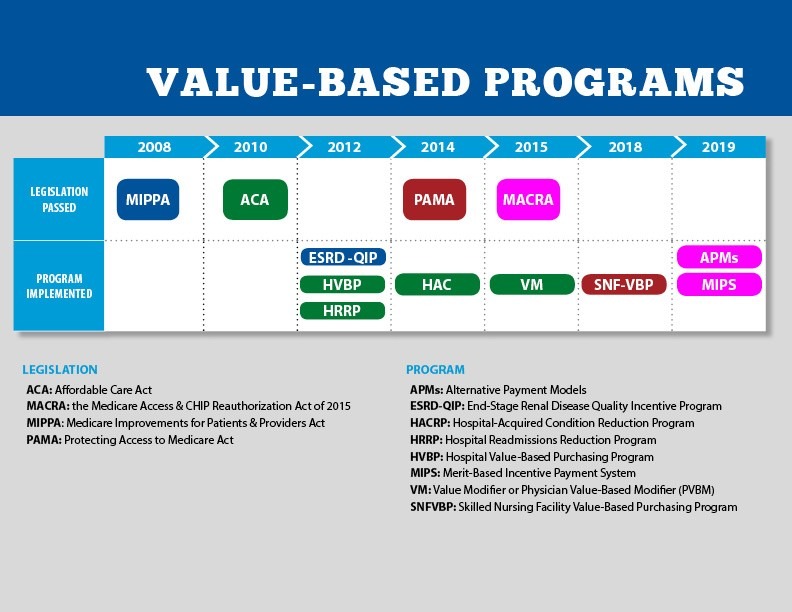
    Medicare changed reimbursement methodology in the 1980s by introducing Relative Value Units (RVUs) and the RBRVS (Resource-Based Relative Value System) for physician reimbursement.  Prior to this time, commercial carriers were already pushing HMOs (health maintenance organizations) and capitation contracts with physician networks or instituting "reasonable and customary charges" requiring physicians to collect data to negotiate reasonable contracts.  Hospital reimbursement also changed.  In 1983 Medicare shifted to the inpatient Prospective Payment System (PPS) and DRGs (Diagnostic Related Groups) and only paying a limited number of days to the hospital regardless of the actual length of stay.  Medicare also encouraged improved hospital performance through the Hospital-Acquired Condition (HAC) Reduction Program, which is a Medicare value-based purchasing program that reduces payments to hospitals based on their performance on measures of hospital-acquired conditions (HACs). The HAC Reduction Program encourages hospitals to improve patients’ safety and implement best practices to reduce their rates of infections associated with health care.  During this time (1980s - early 1990s) health spending increased at an accelerated which can be attributed to expensive new medical technologies and the curtailing of the ambitious HMO-promoting programs of the 1970s.

    Those providers who were not prepared to manage the new reimbursement often resorted to “enhancing” revenue through “creative” means.  As payers investigated insurance fraud, waste and abuse, increased oversight was implemented by creating Special Investigation Units (SIU) by many carriers and additional oversight by the Office of Inspector General (OIG) and stricter laws, such as the Antikickback Statutes, False Claims Act, Physician Self-Referral Law (Stark) with the Health Insurance Portability and Accountability Act of 1996 (HIPAA) establishing a national Health Care Fraud and Abuse Control Program (HCFAC or the Program) under the joint direction of the Attorney General and the Secretary of the Department of Health and Human Services (HHS).

    As more and more potential and real fraud, waste, and abuse was uncovered in the FFS arena, it was also discovered that patient outcomes were less than stellar. The poor quality of care, inefficiencies, and total cost to the U.S. healthcare system were exorbitant.

    Centers for Medicare & Medicaid Services (CMS)

    The Centers for Medicare & Medicaid Services (CMS) is using value-based programs to reward health care providers with incentive payments for the quality of care they provide to Medicare beneficiaries & support a three-part aim including:

    • Better care for individuals
    • Better health for populations
    • Lower costs

    2004 Risk Adjustment Implemented by CMS

    Hierarchical condition category (HCC) coding is a risk-adjustment model originally designed to estimate future health care costs for patients. The Centers for Medicare & Medicaid Services (CMS) HCC model was initiated in 2004 and is becoming increasingly prevalent as the environment shifts to value-based payment models.  Risk adjustment is a reimbursement method originally designed to estimate future health care costs using Hierarchical Condition Category (HCC) coding which are to be submitted annually beginning January 1st.

    Please note that accuracy of data collection is critical.  Please reference the list of terms below under “Metrics”.  Data quality, accuracy, completeness, consistency and predictive analytics all apply to HCC.

    Value Based Programs are important in helping to move toward paying providers based on the quality rather than the quantity of care provided.  The 5 original CMS Value based programs:

    • End-Stage Renal Disease Quality Incentive Program (ESRD QIP)
    • Hospital Value Based Purchasing Program (HVBP)
    • Hospital Readmission Reduction Program (HRRP)
    • Value Modifier Program (Physician Value Based Modifier/PVBM)
    • Hospital Acquired Conditions Reduction Program (HAC)

    Two additional programs:

    • Skilled Nursing Facility Value -Based Purchasing (SNF-VBP)
    • Home Health Value Based Purchasing (HHVBP)

    Going back to at least 2008, different legislation including MIPPA (Medicare Improvements for Patients and Providers Act) was passed. These different Acts initiated the testing of alternate forms of delivering care and payment methodologies. The image below is the timeline from CMS.GOV regarding Medicare specific value-based programs and a more aggressive government initiative to institute reimbursement for Value-Based Care (VBC).


    VBC is the current attempt to undo the perfect storm in healthcare. VBC is patient-focused and looks to increase the quality, coordination, and access to care, while reducing the cost of care. There are four types of prevalent VBC models:

    1. Pay for Performance can be a combination of FFS reimbursement plus additional incentives for providers/facilities to meet specified quality metrics. Overtime, metrics have been developed by many organizations including, the National Quality Forum (NQF), the Joint Commission, the National Committee for Quality Assurance (NCQA), the Agency for Health Care Research and Quality (AHRQ), and the American Medical Association (AMA).
    2. Bundled payments group together a service, procedure, hospital stay, or condition along with multiple service providers are needed to perform the service (e.g., hospital, outpatient provider group, specialty care, radiology, laboratory). A dollar amount is allocated for the service and any cost containing savings are distributed back to the service providers. These service providers are required to coordinate care amongst each other, in order to maximize cost containment. If the cost exceeds the allocated amount, then the services providers would be responsible for covering the exceeded cost.
    3. Shared Savings (e.g., ACO) combines quality care outcomes with reduced healthcare spending by having collaborative and coordinated care amongst the service providers. There is more financial risk for service providers participating in Share Savings programs, but there is also more financial incentive when quality and cost-efficiency are maximized.
    4. Capitation (e.g., MA/HMO) is typically used by Health Maintenance Organizations and Medicare Advantage Organizations. A per member per month (PMPM) reimbursement is established by the insurance company and the service provider has to manage all care within the PMPM payment received. The patient’s care is managed by a gatekeeper (aka Primary Care Provider (PCP)) who coordinates all care (ideally in an outpatient setting) amongst other in-network service providers.
    • This is the riskiest model since there is both upside and downside risk that the gatekeeper is responsible for.
    • Reimbursement can fluctuate based on the (good or poor) health of the patient. Diagnosis codes submitted to the payer determine reimbursement levels…the more ill the patient (with chronic disease(s)), the more the reimbursement allocated to the patient.

    In all of these models, knowing how your business is running is key to managing outcomes. The main way of knowing how your business is running is through understanding your numbers. Having relevant, accurate, and timely data analytics is one of the most important keys to success in any healthcare organization.

    Metrics

    Data analytics metrics are used to assess the performance, effectiveness, and impact of data analytics processes, projects, and initiatives. These metrics help organizations understand how well they use data to make informed decisions. Testing the accuracy of the data your organization is collecting is critical.  Inaccurate data could cause C-Suite Executives to lose confidence in your abilities, whether you are in-house working as part of the workforce in the finance department or a consultant.

    Specific metrics may vary depending on the goals of the analytics project and the nature of the data being analyzed. Please see some of the most commonly used data analytics metrics below:

    Key Performance Indicators (KPIs) are essential metrics that directly align with an organization's strategic goals. They can be financial, operational, or customer-focused. Examples include revenue growth, customer retention rate, and cost reduction.

    Data Quality: Metrics related to data quality assess the accuracy, completeness, consistency, and reliability of the data being analyzed. Examples include data accuracy, data completeness, and data consistency.

    Data Processing Time: This metric measures the time it takes to collect, clean, transform, and load (ETL) data before it can be used for analysis. Reducing data processing time can lead to more timely insights.

    Data Accuracy: It quantifies how precise and error-free the data is. High data accuracy is crucial for making reliable decisions.

    Data Completeness: This metric evaluates the proportion of data that is present compared to the total expected data. Incomplete data can lead to biased or unreliable results.

    Data Consistency: Data consistency measures how well data is aligned and harmonized across different sources and systems. Inconsistent data can lead to discrepancies and confusion.

    Data Volume: The amount of data being processed or stored. It can help determine storage and processing needs.

    Data Velocity: This metric assesses how quickly data is generated, collected, and processed. It's particularly relevant for real-time or near-real-time analytics.

    Data Variety: Data analytics often involve different data types (structured, unstructured, semi-structured). Measuring data variety helps ensure that diverse data sources are appropriately managed.

    Data Latency: The time delay between data collection and its availability for analysis. Low-latency data is crucial for real-time analytics.

    Data Retention Rate: Measures how long data is stored and maintained for future analysis. It's important for compliance and historical trend analysis.

    Data Accessibility: This metric gauges how easily data can be accessed and utilized by analysts and decision-makers.

    Data Security and Compliance: Metrics related to data security and compliance assess the protection of sensitive data and adherence to regulatory requirements, like GDPR or HIPAA.

    Data Usage and Adoption: Measures how frequently and effectively data analytics tools and insights are used by the intended audience within the organization.

    ROI (Return on Investment): Evaluates the value generated from data analytics initiatives compared to the resources and costs invested.

    User Engagement and Satisfaction: Metrics related to user experience and satisfaction with data analytics tools and dashboards.

    Model Accuracy and Performance: For machine learning and predictive analytics, these metrics assess how well models perform in making accurate predictions.

    Data Visualization Effectiveness: Measures the clarity and usefulness of data visualizations in conveying insights.

    Data Governance Metrics: These include metrics related to data cataloging, metadata management, and data stewardship practices.

    Data-driven Decision-Making: Metrics that track how data analytics influences and improves organizational decision-making.

    It's crucial to select and track the metrics that align with the specific objectives and context of your data analytics projects. Regularly reviewing and analyzing these metrics can help organizations make data-driven improvements and achieve better results.

    Conclusion

    We can count on payers continuing to shift the burden of cost to providers.  And, it is expected that providers will continue to strive to provide quality and safe care at a reasonable cost.  However, with rising inflation, sky-rocketing expenses for the latest technology and the use of Artificial Intelligence (AI) integrated into our health care systems (which doesn’t come cheap), the ONLY way providers will financially survive a VBC environment is to negotiate appropriate, reasonable terms with payers based on accurate and reliable data. 

    This article is written by members of the AIHC Volunteer Education Committee.  AIHC is a non-profit organization.  We value our members, credentialed professionals and greatly appreciate the talents offered by our member volunteers!

    Copyright © 2023 American Institute of Healthcare Compliance All Rights Reserved

    Read More
    Healthcare Revenue Cycle Compliance
    Billing/RCM

    How to Enhance Denial Management for Mental Health Billing Services in 2023-24


    Written by: James Smith   


    Introduction   

    In the complex world of healthcare billing, mental health services require a tailored approach due to the unique nature of the field. With the year 2023 underway, mental health billing services face challenges and opportunities. Among the essential aspects of this process is effective denial management. This article explores the key components of a robust denial management process and why it is particularly important for mental health billing services this year.

    Understanding Denial Management

    Denial management involves a series of strategic actions aimed at identifying, addressing, and mitigating claim denials from insurance providers. In the context of mental health billing, the significance of this process cannot be overstated. Claim denials can occur for various reasons, including incorrect documentation, coding errors, or issues related to insurance eligibility.

    Key Components of Effective Denial Management

    Proactive Eligibility Verification:

    A fundamental component of denial management is proactive eligibility verification. Mental health billing services should rigorously verify the insurance coverage and eligibility of patients before providing services. This preemptive step helps prevent denials linked to coverage issues.

    Accurate Documentation and Coding:

    Precise and comprehensive documentation is critical. Mental health billing services must ensure that all services are accurately documented, and the corresponding diagnosis and procedure codes are correct. Errors in coding or incomplete information can lead to denials.

    Timely Claims Submission:

    Timeliness is paramount. Mental health billing services must adhere to the claims submission deadlines stipulated by insurance companies. Failing to submit claims promptly can result in automatic denials.

    Thorough Denial Analysis:

    When a denial is received, thorough analysis is necessary. Mental health billing services should pinpoint the specific reason for the denial, be it coding errors, lack of medical necessity, or other issues. This analysis is the compass for corrective actions.

    Corrective Actions and Resubmission:

    Based on the denial analysis, mental health billing services should take corrective actions to rectify the issues. This may involve revising documentation, appealing the denial, or resubmitting claims with necessary adjustments.

    Denial Prevention:

    The ideal approach to denial management is preventing denials in the first place. This can be achieved through ongoing staff training, staying updated on industry changes, and implementing quality assurance measures to minimize errors.

    Significance of Denial Management in Mental Health Billing Services

    Denial management holds a pivotal role in the realm of mental health billing services for various reasons:

    Financial Stability:

    Effective denial management ensures a steady cash flow for mental health providers. Promptly resolving denials guarantees they receive payment for their services, which is essential for the financial stability of their practices.

    Compliance and Ethical Billing:

    It enforces compliance with billing regulations and ethical standards. Mental health billing services must ensure that services billed for are genuinely provided and medically necessary, adhering to ethical billing practices.

    Reduced Administrative Burden:

    Outsourcing denial management to specialized services reduces the administrative burden on mental health providers. This allows them to focus on patient care, a critical aspect of their role.

    Enhanced Patient Experience:

    Swift resolution of denials and accurate billing practices enhance the patient experience. Patients are less likely to be surprised by unexpected bills or insurance-related issues, leading to greater satisfaction.

    Long-Term Cost Savings:

    By preventing denials and optimizing the billing process, mental health providers can achieve long-term cost savings and increased revenue. A more efficient process can contribute to sustainable financial growth.

    Frequently Answers Questions

    Q1: What is denial management in the context of medical billing?

    A1: Denial management is the process of identifying, addressing, and preventing claim denials from insurance providers. It involves actions to rectify errors or issues that lead to claims being denied and to ensure accurate and timely reimbursement for healthcare services.

    Q2: Why is denial management particularly important for mental health billing services in 2023?

    A2: Mental health billing services face unique challenges related to diagnosis codes, medical necessity, and the need for thorough documentation. Effective denial management is crucial to maintain financial stability, ensure compliance, and enhance the patient experience.

    Q3: What are some common reasons for claim denials in mental health billing?

    A3: Claim denials in mental health billing can occur due to errors in documentation, coding mistakes, lack of medical necessity, insurance eligibility issues, and failure to meet claims submission deadlines, among others.

    Q4: How can mental health billing services proactively prevent claim denials?

    A4: Prevention can be achieved through proactive eligibility verification, ongoing staff training, staying updated on industry changes, and implementing quality assurance measures to minimize errors in documentation and coding.

    Q5: What should mental health providers do when they receive a claim denial?

    A5: When a claim is denied, mental health providers should conduct a thorough analysis to determine the specific reason for the denial. Once identified, corrective actions should be taken, such as revising documentation, appealing the denial, or resubmitting claims with necessary adjustments.

    Q6: Can mental health billing services outsource denial management?

    A6: Yes, many mental health billing services choose to outsource denial management to specialized billing companies. Outsourcing medical billing can help reduce the administrative burden on providers and ensure that denial management is handled by experts in the field.

    Q7: How does effective denial management benefit mental health providers and patients?

    A7: Effective denial management ensures a steady cash flow for providers, maintains compliance with billing regulations and ethical standards, reduces administrative burdens, enhances the patient experience by preventing billing surprises, and contributes to long-term cost savings and increased revenue.

    Q8: What role does accurate documentation and coding play in denial management for mental health billing services?

    A8: Accurate documentation and coding are crucial to prevent denials. Mistakes in these areas can lead to denials, and addressing such issues is a key part of the denial management process.

    Q9: How can mental health billing services stay updated on industry changes and regulations in 2023?

    A9: Staying updated can be achieved through continuous staff training, engaging with industry associations, subscribing to newsletters, and participating in webinars or conferences focused on mental health billing and healthcare regulations.

    Q10: Are there specific software or tools that can aid in denial management for mental health billing services?

    A10: There are various practice management and billing software solutions that offer denial management features, helping streamline the process. Choosing the right software and tools depends on the specific needs of the mental health billing service.

    Conclusion

    In conclusion, effective denial management is a linchpin of mental health billing services in 2023. It ensures financial stability, promotes compliance, and enhances the overall patient experience. Mental health billing services should be proactive in addressing denials, prioritize accuracy, and continually seek ways to prevent denials, ultimately benefiting both providers and their patients in this evolving landscape.

    Author Bio:

    James Smith is a dedicated writer and healthcare enthusiast with a passion for simplifying complex medical billing topics. As a valued member of the Zee Medical Billing, a best medical billing company in the United State, he is committed to helping healthcare professionals and organizations navigate the ever-evolving landscape of medical billing, ensuring that they receive accurate and timely reimbursements for their vital services.


     Copyright © 2023 American Institute of Healthcare Compliance All Rights Reserved 

    Read More
    Healthcare Revenue Cycle Compliance
    Billing/RCM

    How to Achieve an Efficient Cardiology Medical Billing Process

    Written by: Eve Liam  


    The evolving healthcare industry makes the revenue cycle management complex and billing teams need to stay aligned with the latest updates. Likewise, changes in the billing guidelines and technology integration in healthcare makes cardiology medical billing challenging. In addition, billers and coders who handle cardiology RCM processes should be qualified enough to ensure quality reimbursements. Further, cardiologists need to keep the cash flow consistent and drive better patient health outcomes. An efficient billing process leads to greater productivity, improved profitability, and reduced denial rates. Let’s see how cardiology practices can achieve an efficient billing process. 


    Improve Clinical Documentation

    Accurate clinical documentation is the most important aspect of an efficient revenue cycle management. In addition, documentation is used to maintain healthcare information of the patients which is used to submit claims. Similarly, it improves the quality of the health records and acts as a foundation of the revenue cycle. As a result, cardiology practices can achieve full and on-time reimbursements from payers. Hiring cardiology billing services can help improve clinical documentation and guarantee complete payments. Appropriate documentation makes it easier for all the stakeholders to understand the services offered to the patients.

    Verifying Insurance Eligibility

    Checking the insurance details help cardiology practices to get details of patient’s insurance coverage, copayments, and deductibles. In addition, this process gives a complete idea about the patient’s insurance and helps providers save their time and money. Offering services which are not covered by the insurance company leads to claim denials and revenue losses. So, billing services for cardiology practices streamline cash flow and prevent claim denials. Knowing the patient’s eligibility before the appointment scheduling saves time and helps practices to find out which services to offer.

    Perform Medical Billing Audits

    To make sure that the billing process is running efficiently, cardiology practices need to find problematic areas in the RCM cycle. The best way to find errors in the billing process is to perform a medical billing audit. In addition, cardiology medical billing audits help you identify key areas that need immediate attention. As a result, practices are able to check the effectiveness of the clinical documentation and the billing process. Third-party RCM vendors offer billing audit services for specialty practices. If it is not easier for cardiology practices to perform an in-house billing audit, they can outsource it. Moreover, going for an external audit helps to scrutinize the overall revenue cycle management process.

    Keep Aligned with the Billing and Coding Changes

    Healthcare industry rules are constantly changing and billing staff should stay updated with the latest rules. Additionally, medical practices can reduce revenue leakages and optimize the revenue cycle process by staying updated with the latest rules. CMS keeps on updating the guidelines on how to bill and code for services cardiologists render. Thus, it is essential to stay updated with the latest guidelines and submit clean claims for optimal payments. Getting billing services for cardiology practices reduce the chances of errors because third-party billers are updated with the latest changes. Further, it increases the efficiency of the overall revenue cycle management process and allows practices to improve workflow efficiency.

    Outsource Cardiology Billing to Experts

    There is always an option to hire industry experts who are well-versed with the ins and outs of the billing process. Also, the staff of medical billing companies is certified and highly professional. In this way, outsourcing billing helps cardiology practices to streamline revenue cycle and achieve an efficient billing process. In addition, RCM companies are updated with the latest developments in the healthcare industry with respect to billing guidelines. So, hiring third-party billing services can help optimize profitability and increase workflow efficiency. Further, cardiologists can improve the health conditions of patients by focusing on providing quality care. Consequently, it can significantly improve the health conditions of the patients.

    Prevent Medical Billing and Coding Errors

    Accuracy is the most important thing when it comes to the claim submission process. In addition, clinical documentation should be accurate to ensure error-free claim submission. Also, an efficient claim scrubbing process improves the chances of claim acceptance. Likewise, cardiologists can reduce payment delays and claim denials with billing and coding accuracy. The billing staff should know the correct and the latest CPT codes required to submit claims. Moreover, lesser chances of claim denials mean greater chances of greater reimbursements. So, cardiology practices should focus on submitting accurate claims to the payers and make the billing process efficient. Lesser errors lead to an effective medical billing process and streamline payments from payers.

    Final Thoughts

    Not having an efficient cardiology medical billing process makes it difficult to manage the revenue cycle efficiently. In addition, an effective claim submission process should be properly implemented to ensure seamless reimbursements and avoid potential revenue losses. Similarly, eligibility verification and prior authorization help save time and effort for providers. To keep medical billing efficient, it is essential to perform regular audits and stay updated with the billing guidelines. Lastly, outsourcing helps to work with industry experts who can help reduce billing errors, mitigate compliance risks, and help achieve timely reimbursements.

    Author Biography:

    Eve Liam has been working as a Medical Billing and Coding expert for the last eight years with a widely known and reputed medical billing services provider
    Physician Billing Company. Eve is known for her expertise in Healthcare Information Technology, Revenue Cycle Management Training, and Healthcare Management, and her unique tactics to deal with medical billing claims bring drastic changes in annual revenue.

    Copyright © 2023 American Institute of Healthcare Compliance All Rights Reserved

    Read More