Auditing, Managing Denials Is Important to Good A/R Hygiene
Auditing

Part 3: Audit Documentation to Avoid Potential Appeal Consequences

Written by: AIHC Blogger


This article provides educational information related to mitigating the risk of an unwarranted payer investigation. Only appeal claims when you have evidence and supporting documentation to substantiate your right to payment. This is the final article in a 3-part series on denials and appeals management. Read Part 1 entitled “Managing Denials Is Important to Good A/R Hygiene” posted March 22, 2022, and Part 2 entitled “Understanding How Payers Deny Claims.”


Audit Coding, Billing and Documentation for Accuracy


Insurance carriers and government contractors have the authority to review any claims at any time. Due to the huge volume of claims payers receive to process, deny and pay, they have implemented various methods to track providers to detect potential waste, fraud and/or abuse.


Providers may take documentation “short cuts” or feel overwhelmed with implementation of a new EMR (electronic medical record) system and clone or make documentation errors. It is important to detect any problematic areas prior to filing an appeal. 


Lack of detailed supporting documentation submitted with an appeal can not only result in another denial, but also in “flagging” your practice as being high-risk on the spectrum of potential fraud and/or abuse. It can result in a situation where insurance opens an investigation or decides to initiate periodic audits on your claims and records. When you believe the payer is making the mistake, push back by exhausting all appeal rights allowed. If the payer, such as Medicare, performs an extrapolation, reducing each overpayment dollar through appeal can mean thousands less to pay back.


Utilize the information provided in the Part 2 article, such as ensuring the claim meets Medical Unlikely Edits, bundling, diagnosis and medical necessity guidelines. All modifiers should be appropriately appended and supported in the medical record. A great free modifier resource to share with you is the CMS Medicare Administrative Contractor (MAC) “WPS” learning center with on-demand training materials. Click here for the WPS modifier page (choose a region, the website will take you to the page).


Place of Service (POS) can be a “trigger” for an investigation. If the claim is coded POS 11 for the office, reimbursement can be higher than if the same service was performed at the hospital by the provider. Audit the POS to ensure this was coded correctly on the claim. A complete national POS code set and instructions are provided in CMS Internet-only Manual (IOM) Publication 100-04, Chapter 26, Section 10.5 at:  

https://www.cms.gov/regulations-and-guidance/guidance/manuals/downloads/clm104c26pdf.pdf


Is the date of service (DOS) correct? When the medical record date doesn’t match the date filed on the claim, you may have a difficult time arguing an appeal. Payers always require documentation for the date of service filed (and paid) on the claim. When the DOS is incorrect, accept the denial. If you have not passed the timely filing deadline, re-file the claim with the correct DOS.


Audit to ensure your organization has no excluded individuals employed


An example of a case settled in 2022 is Windham Eye Group, an ophthalmology practice paying $192,000 for employing an excluded practice administrator. Please make sure your organization routinely screens employees to ensure none are on the OIG exclusions list. Prior to appealing a Medicare, Medicaid, TriCare or other Federal Program claim, you should verify that your organization is compliant in this area (click here). 


Evidence of Medical Necessity


Medical necessity includes frequency, duration, previous conservative treatment (that failed) and other factors. However, it also includes documentation of a supporting diagnosis.


The diagnosis coding on the claim is one of the first items insurance will review to qualify the claim as being “medically necessary.” Once the diagnosis coding passes through the insurance company edits, additional edits will then be performed against medical necessity criteria. 


Diagnosis codes are an important compliance aspect of reporting medical necessity on the claim. They are also a large contributing factor for potential fraud and abuse when documentation does not support the diagnoses reported. Auditing the diagnoses on the claim to documentation is a critical review step to determine whether the claim should be appealed.

  • Diagnoses should be sequenced according to coding guidelines.
  • Each line-item on the claim should be linked to the appropriate procedure code.
  • Audit the code to ensure all characters are accurate.
  • Each condition reported on the claim must be documented in the patient’s chart.
  • Verify that the primary diagnosis is listed as “medically necessary” for the treatment provided.

Detect a Problem?


During the course of auditing or reviewing documents related to a denied claim, you may identify situations where further investigation is necessary. You may state it is simply a billing error. Errors made over and over in high volume or high dollar amounts will be interpreted as more than a simple billing mistake by payers. 

  • Make careful consideration before appealing denials found on an investigational probe. 

Obtaining legal advice before proceeding with an appeal may be necessary under certain circumstances. 


Carrier SIU Situations


Insurance carriers have departments called Special Investigation Units or “SIU” with trained professionals carefully reviewing allegations of suspected fraud and abuse. 


When a probe or investigation is initiated by a payer in writing or in-person, it is likely the investigators have already been speaking with your billing staff and patients to gather information to establish a case against you.


Can the investigators “get it wrong”?  They can, sometimes!


There are times when investigators believe the situation is intentional (fraud) when the problem actually is being caused by lack of internal controls, auditing and monitoring by the provider. This allows errors to continue for prolonged periods of time.  


When your office receives the results of the SIU (carriers) probe, the letter will provide guidance regarding ability to appeal. If you are given the option to appeal, have evidence of a strong argument to support that these claims should be paid. If you can’t meet the deadline to appeal, request an extension to buy more time to audit and properly prepare your appeal argument. 


If your organization has a Compliance Officer and/or Certified Healthcare Auditor, you may want to bring concerning situations to his/her attention. Never file an appeal when you believe documentation may be evidence of fraud or abuse. You may need assistance from someone more highly trained in this area to determine this. If in doubt, check it out.


When speaking with your provider, Compliance Officer, Auditor or an attorney, the “short” list of rules and regulations which apply to medical coding, documentation and billing are listed below. 

  • False Claims Act (FCA);
  • Anti-Kickback Statute (AKS);
  • Physician Self-Referral Law (Stark Law);
  • Social Security Act; and
  • United States Criminal Code.

The difference between “fraud” and “abuse” depends on specific facts, circumstances, intent, and knowledge. Examples of abuse can include such things as:

  • Billing for unnecessary medical services (lack of medical necessity);
  • Charging excessively for services or supplies;
  • Misusing codes on a claim, such as upcoding or unbundling codes;

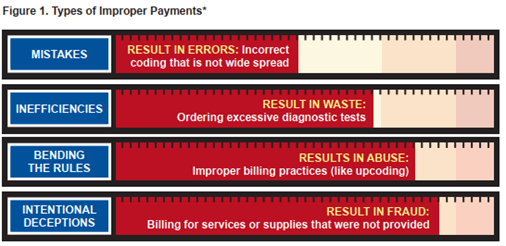
According to the Medicare Integrity Program, activities which target various causes of improper payments are items such as those in the chart below.

The government's primary civil tool for addressing healthcare fraud is the False Claims Act (FCA).

  • Most FCA cases are resolved through settlement agreements in which the government alleges fraudulent conduct and the settling parties do not admit liability.
  • Based on the information it gathers in a FCA case, the Office of Inspector General (OIG) assesses the future trustworthiness of the settling parties (which can be individuals or entities) for purposes of deciding whether to exclude them from the Federal healthcare programs or take other action.

The OIG's efforts to curb fraud include:

  • Conducting criminal, civil, and administrative investigations of fraud and misconduct related to HHS programs, operations and beneficiaries;
  • Using state-of-the-art tools and technology in investigations and audits around the country;
  • Imposing program exclusions and civil monetary penalties on health care providers because of criminal conduct such as fraud or other wrongdoing;
  • Negotiating global settlements in cases arising under the civil False Claims Act, developing and monitoring corporate integrity agreements, and developing compliance program guidance.

Because OIG's assessment of the risk posed by a FCA defendant may be relevant to various stakeholders, including patients, family members, and healthcare industry professionals, the OIG makes information public about where a FCA defendant falls on the risk spectrum.
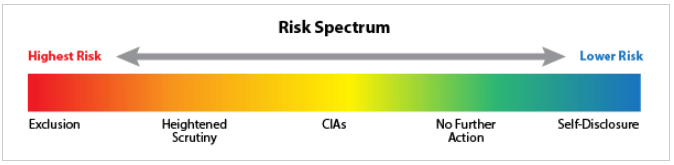

The five risk categories on the spectrum are defined below:


Highest Risk:  Exclusion

  • Parties that OIG determines present the highest risk of fraud will be excluded from Federal healthcare programs to protect those programs and their beneficiaries. Excluded individuals and entities are listed in OIG's Exclusions Database.

High-Risk:  Heightened Scrutiny

  • Parties are in the High-Risk category because they pose a significant risk to Federal healthcare programs and beneficiaries. This is because, although OIG determined that these parties needed additional oversight, they refused to enter Corporate Integrity Agreements (CIAs) sufficient to protect Federal healthcare programs. Parties in the High-Risk category that reached settlements since on October 1, 2018, or later are listed here.

Medium risk:  CIAs or Corporate Integrity Agreements

  • Healthcare providers and other entities in the Medium Risk category have signed CIAs with OIG to settle investigations involving Federal healthcare programs. Under these agreements, parties promise to fulfill various obligations in exchange for continuing to participate in the programs.

Lower Risk:  No Further Action

  • The OIG sometimes concludes that parties present a relatively low risk to Federal healthcare programs. As a result, OIG is not seeking to exclude them from those programs or require a CIA. OIG's cases against these parties are closed without evaluating the effectiveness of any efforts the parties have made to ensure future compliance with Federal healthcare program requirements.

Low Risk:  Self-Disclosure

  • A party may disclose evidence of potential fraud related to Federal healthcare programs to OIG. The OIG believes that doing so in good faith and cooperating with OIG's review and resolution process generally demonstrates that the party has an effective compliance program. OIG works to resolve such cases faster, for lower settlement amounts, and with a release from potential exclusion with no CIA or other requirements. More information about OIG's self-disclosure protocol – click here.

This ends Part 3 for the denials and appeals article series. There is so much more to share with you, however, as you can see, filing an appeal involves various considerations and skill sets. Register, train and certify in Appeals Management - Online, On-Demand! 


Read More
Healthcare Revenue Cycle Compliance
Billing/RCM

Part 2: Understanding How Payers Deny Claims

Written by: AIHC Blogger


This article provides educational information related to fighting unreasonable denials by working through a complex payer appeals process. This information is not all-inclusive and the article is a truncated version of Lesson 3 from our Certified Outpatient Clinical Appeals Specialist (COCASSM) training program. The complex Medicare appeals process is used to demonstrate the importance of appealing claims denied in an audit. Make sure to read Part 1: Managing Denials is Important to Good A/R Hygiene.


Audited by a payer?  


Is your organization under a payer audit? Fight back by appealing unreasonable denials. But first, learn more about how a complex payer audit system works. 


Understanding how a payer reviews and makes a payment determination will strengthen your ability to argue and defend your claim upon appeal. The learning objective of this lesson is to help you become familiar with the Medicare Claims Review Program (MCRP). This program monitors inappropriate payments. Other payers mirror Medicare’s program.


What is an “improper” payment?


These are reimbursements that should not have been made or that were made in incorrect amounts. According to the U.S. Government Accountability Office (GAO), improper payments have been estimated to total almost $1.7 trillion government-wide from fiscal years 2003 through 2019. Auditing and denying claims after the claims have been paid is “big money” for the government. 

  • For example, the GAO states that they identified about $77.6 billion in financial benefits in fiscal year 2020—a return of about $114 for every $1 invested.
  • They also identified 1,332 other benefits that led to program and operational improvements across the government.
  • Most recently, GAO has been evaluating the largest response to a national emergency in US history, the $2.6 trillion COVID-19 response legislation, and making recommendations about how to improve its effectiveness in dealing with public health issues and the economy.

The Medicare Fee-for-Service Compliance programs prevent, reduce, and measure improper payments in FFS Medicare through medical review. A number of programs are provided to educate and support Medicare providers in understanding and applying Medicare FFS policies while reducing provider burden.


A Medicare contractor may use any relevant information they deem necessary to make a prepayment or post-payment claim review determination. This includes any documentation submitted with the claim or through an additional documentation request.


CMS' Center for Program Integrity (CPI) oversees Medicare medical review contractors. CPI conducts contractor oversight activities such as:

  • Providing broad direction on medical review policy
  • Reviewing and approving Medicare contractors' annual medical review strategies
  • Facilitating Medicare contractors' implementation of recently enacted Medicare legislation
  • Facilitating compliance with current regulations
  • Ensuring Medicare contractors' performance of CMS operating instructions
  • Conducting continuous monitoring and evaluation of Medicare Contractors' performance in accord with CMS program instructions as well as contractors' strategies and goals
  • Providing ongoing feedback and consultation to contractors regarding Medicare program and medical review issues

The Medicare Claims Review Program, or “MCRP,” involves both technical and clinical categories of denials performed by CMS contractors. It is a complex system, perfect to use as a teaching example! There are two categories of denials:


1. Technical Denial & Rejection
     • This topic has been covered in previous lessons, but let’s review again!

o A technical denial is an error made when filing the claim, such as lack of appropriate coordination of benefits and filing to secondary insurance first. When a critical error gets through the scrubber, the insurance payer software may reject the claim due an error. Correcting these types of errors quickly and refiling the claim typically results in payment. These claims often “fall through the cracks” and can be suspended. Lack of tending to rejected claims can cause huge revenue loss for your organization.


2. Clinical Denial
    • A clinical denial is the denial of payment by an insurance payor on the basis of medical necessity, length of stay or level of care. Special review of documentation, payer guidelines and often appealing the claim is required to obtain payment.

o When a payer sends an RFI (Request for Information), the payer is auditing the claim data against medical record documentation.
o Untimely response to the RFI will result in a denial.
o Sending inappropriate or wrong information to the payer will result in a denial.
o These types of denials can potentially trigger a larger audit, a probe, or an abuse or fraud investigation of your organization


CMS estimates the Medicare FFS improper payment rate through the Comprehensive Error Rate Testing (CERT) program. Each year, the CERT program reviews a statistically valid stratified random sample of Medicare FFS claims to determine if they were paid properly under Medicare coverage, coding, and payment rules.


Audits or claim reviews are conducted either prepayment or post-payment of the claim and typically fall under one of these categories:

  • Compliance to bundling edits (Medicare’s National Correct Coding Initiative or NCCI Edits)
  • Medically Unlikely Edits or “MUEs”
  • Comprehensive Error Rate Testing (CERT)
  • Recovery Audit Program
  • Medical Reviews (MRs)

National Correct Coding Initiative (NCCI) Edits


CMS developed the National Correct Coding Initiative (NCCI) to promote national correct coding methodologies and to control improper coding leading to inappropriate payment in Part B claims. The Centers for Medicare & Medicaid Services (CMS) owns the NCCI program and is responsible for all decisions regarding its contents.


Most payers either use the NCCI edits or have a similar bundling edit system in place. Basically, bundling edits review codes on a claim to determine whether the items can be filed and paid separately or bundled into one code.


The claims scrubber software within your practice management system will analyze the codes on the claim and compare the information to the NCCI edits. Items that should be bundled will be suspended for further review. Your office cannot bill a patient for a service denied due to denied claims based on the NCCI edits.


These edits are updated at least quarterly and revised in your practice management system through updates to the software. Information about the National Correct Coding Initiative (NCCI) can be found in the Internet-Only Manual, Publication 100-04, Section 20.9 of Chapter 23 of the Medicare Claims Processing Manual.


When appealing NCCI edit denials, it is important to review the claim to ensure the appropriate modifier has been used. If not, review the documentation and appropriately append the modifier to the line item on the claim and submit your appeal with the documentation. 


Modifiers allowed with the National Correct Coding Initiative (NCCI) procedure to procedure (PTP) edit that can be used under appropriate clinical circumstances to bypass an NCCI PTP edit include:

  • Anatomic modifiers: E1-E4, FA, F1-F9, TA, T1-T9, LT, RT, LC, LD, RC, LM, RI
  • Global surgery modifiers: 24, 25, 57, 58, 78, 79
  • Other modifiers: 27, 59, 91, XE, XS, XP, XU

NOTE:  Overuse of such modifiers just to get claims passed through the edits for payment can trigger an audit, probe or investigation. 


Medically Unlikely Edit (MUE)


This audit feature analyzes a claim to determine if the appropriate number of units are being reported per line item. It is a unit of service edit for a Healthcare Common Procedure Coding System (HCPCS)/Current Procedural Terminology (CPT) code for services rendered by a single provider/supplier to a single beneficiary on the same date of service (DOS).


The ideal MUE is the maximum unit of service that would be reported for a HCPCS/CPT code on the vast majority of appropriately reported claims. 


MUEs are designed to reduce errors due to clerical entries and incorrect coding. MUEs are adjudicated either as claim line edits or DOS edits.

  • If the MUE is a claim line edit, each line of a claim is adjudicated against the MUE value for the Healthcare Common Procedure Coding System (HCPCS)/Current Procedural Terminology (CPT) code on that claim line.
  • If the UOS on the claim line exceeds the MUE value, all UOS for that claim line are denied. If the same code is reported on more than one line of a claim by using CPT modifiers, each line of the claim is adjudicated separately against the MUE value of the code on that claim line.

For Medically Unlikely Edits (MUEs) that are adjudicated as claim line edits, each line of a claim is adjudicated separately against the MUE value for the code on that line. The appropriate use of Healthcare Common Procedure Coding System (HCPCS)/Current Procedural Terminology (CPT) modifiers to report the same code on separate lines of a claim will enable a provider/supplier to report medically reasonable and necessary UOS in excess of an MUE value.


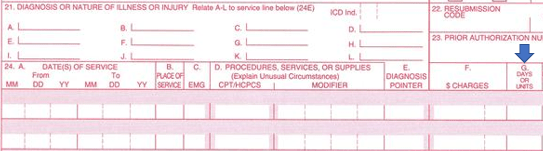
24.G is the field on the 1500 claim being audited for MUE compliance:


These edits are updated at least quarterly and revised in your practice management system through updates to the software. 


Comprehensive Error Rate Testing (CERT) Program


CERT contractors perform a complex medical review of the claim and the supporting documentation to determine whether the claim was paid appropriately according to Medicare coverage, payment, coding, and billing rules.


CMS calculates a national Medicare Fee-For-Service (FFS) improper payment rate and improper payment rates by service type to accurately measure the performance of the MACs and gain insight into the causes of errors. CMS publishes the results of these reviews annually.


The Medicare FFS Improper Payment Rate is a good indicator of how claim errors in the Medicare FFS Program impact the Medicare Trust Fund. CERT errors are listed by the following categories:


The Recovery Audit Program


Most hospitals and clinics are familiar with the “RAC” or Recovery Audit Contractor program – now referred to as the “Recovery Audit Program” by CMS.


RAC's review claims on a post-payment basis by auditing past Medicare FFS claim data for potential overpayments or underpayments and reviewing medical records when necessary to make appropriate determinations. When performing these reviews, Recovery Auditors follow Medicare regulations, billing instructions, National Coverage Determinations (NCDs), coverage provisions, and the respective MAC’s Local Coverage Determinations (LCDs). Recovery Auditors do not develop or apply their own coverage, payment, or billing policies.


In general, Recovery Auditors do not review a claim previously reviewed by another entity. Recovery Auditors analyze claim data using their proprietary software to identify claims that clearly or likely contain improper payments.


Medical Review Audits


Medical reviews identify errors through claims analysis and/or medical record review activities. Contractors use this information to help ensure they provide proper Medicare payments (and recover any improper payments if the claim was already paid). Contractors also provide education to help ensure future compliance.


A Medicare contractor may use any relevant information they deem necessary to make a prepayment or post-payment claim review determination. This includes any documentation submitted with the claim or through an additional documentation request. 


One of the first items reviewed is a valid authentication or signature. Next, auditors typically review documentation for medical necessity; information to support units, laterality, diagnosis coding and supporting documentation such as signed orders or plan of care.


Learn more about clean claims, prompt pay laws, fighting denials based on medical necessity, appealing ERISA denials, the Medicare appeals process, and how to create an effective denials and appeals program – click here and become an Outpatient Clinical Appeals Specialist. Click Here to see if we have any upcoming classroom training camps!

Read More
Healthcare Revenue Cycle Compliance
Billing/RCM

Part 1: Managing Denials Is Important to Good A/R Hygiene

Written by: AIHC Blogger


Too many denied claims to manage? Practicing good revenue cycle management “hygiene” is important – but most don’t know where to start.


This article provides a basic overview of the importance of improving your appeals process to get denials overturned as it relates to overall revenue cycle management. This information is not all-inclusive and is for educational purposes only. We recommend formal training in denials and appeals management and encourage medical billing companies and practice managers gain better insight into accounts receivable (A/R) management through online training and certification.


Revenue cycle management includes tracking claims, making sure payment is received, and following up on denied claims to maximize revenue generation. Several metrics can help you determine whether your revenue management cycle processes are efficient and effective. The first metric is days in accounts receivable (A/R). Days in A/R refers to the average number of days it takes a practice to collect payments due. The lower the number, the faster the practice is obtaining payment, on average.


When a large number of denials are due to a single payer and in a short amount of time, conduct analysis of the situation quickly. Why? This could be an investigation initiated by the payer and may warrant additional assistance to evaluate. You need to know there is a problem and understand the underlying cause before you can resolve it.


According to the American Academy of Family Physicians (AAFP), a 5% to 10% denial rate is the industry average, but keeping the denial rate below 5% is more desirable. Automated processes can help ensure your practice has lower denial rates and healthy cash flow. For most practices, days in A/R should stay below 50 days at minimum; however, 30 to 40 days is preferable and achievable when your revenue cycle team works smart!


Know Your “Days in A/R”


When claims are filed but not paid, days in accounts receivable (A/R) will be higher than your internal historical benchmarks and likely higher than the industry standard for your type of specialty or practice. High days in A/R, or when receivables older than 120 days is greater than 12%, should trigger a signal that improvement is needed – fast! Most of the time improvement in the appeals process is required to avoid writing-off denied claims.


To get the most accurate picture of your practice’s financial standing, base your calculations on the actual age of the claim, i.e., the date of service, not the date on which the claim was filed or when it changes hands from one financially responsible party to another (primary insurance to secondary insurance; insurance to patient). This may mean contacting your vendor to adjust settings in your practice management system to create more meaningful A/R management reports.


How often does your Revenue Cycle Manager (RCM) run a credit balance report? Reconciling accounts with credit balances is the first step toward achieving maximum A/R hygiene. Credit balances are often a neglected aspect of the revenue cycle that can have serious negative effects. Credit balances left unattended can very quickly accumulate to a volume that impacts your accounts receivable reporting and may put your facility at risk for violating federal regulations or your insurance contracts. If your accounts receivable (A/R) reports include credit balances, your A/R will appear better than it actually is as the credits will offset balances due.


Next, calculate the practice’s average daily charges. Add all of the charges posted for a given period (e.g., 3 months, 6 months, 12 months). Then, subtract all credits received from the total number of charges. Next, divide the total charges, less credits received, by the total number of days in the selected period (e.g., 30 days, 90 days, 120 days, etc.). Next, calculate the days in A/R by dividing the total receivables by the average daily charges.


Review Aging Reports


Calculate A/R greater than 120 days using the oldest “buckets” in your aging report to determine how much and from what payers remains unpaid from the date of service to now. To calculate, divide the dollar amount of accounts receivable that is greater than 120 days by the dollar amount of total current accounts receivable, then multiply by 100.


Monitor Reports for Inappropriate Write-Offs


Are accounts reconciled and overpayments identified and handled properly? After careful review, are there adjustments made to accounts that have no paper trail or explanation posted on the account? Are there mistakes made with auto (or manual) posting of contractual adjustments? When your practice fails to distinguish between noncontractual adjustments and contractual adjustments, results may provide a misleading view of how well your practice collects the money it has earned. It can also be a sign of potential embezzlement. Categorizing noncontractual adjustments (e.g., “untimely claims filing” or “failure to obtain prior authorizations”), will help reveal sources of errors and identify opportunities to improve revenue cycle performance.


Managing the issues listed above should come first. Then, move on to calculating and improving your denial rate.


Know Your Claims Denial Rate


The denial rate represents the percentage of claims denied by payers during a given period. This metric quantifies the effectiveness of your revenue cycle management processes. A low denial rate indicates cash flow is healthy and fewer staff members are needed to maintain that cash flow.


A 5% to 10% denial rate is the industry average; keeping the denial rate below 5% is more desirable. Automated processes can help ensure your practice has lower denial rates and healthy cash flow.


To calculate your practice’s denial rate, add the total dollar amount of claims denied by payers within a given period and divide by the total dollar amount of claims submitted within the given period.


The lower the denial rate, the fewer revenue cycle workforce members are needed to manage receivables.


Analyze Denials Data


Root cause analysis or RCA may be helpful for your organization to avoid the “band aid” approach and resolve underlying contributing factors, such as inaccurate coding, documentation and/or billing practices. Revenue Cycle Managers are encouraged to obtain some training in compliance auditing. A good program should include basics in RCA and statistical analysis.


Use the Pareto Principle – the “80/20 Rule” to get organized and maximize revenue!


The 80/20 Rule means that in anything, a few (20 percent) are vital and many (80 percent) are trivial. Project Managers know that 20 percent of the work (the first 10 percent and the last 10 percent) consume 80 percent of your time and resources. You can apply the 80/20 Rule to almost anything, from the science of management to the physical world. The value of the Pareto Principle for a manager is that it reminds you to focus on the 20 percent that matters.


According to the Pareto Principle, of the things achieved during your day, only 20 percent really matter. Those 20 percent produce 80 percent of your results. Identify and focus on those things.


Don't just "work smart," work smart on the right things. It applies to denials management as follows:


The insurance companies you bill most – the top 20 percent of your payers are likely to contribute 80% of all insurance revenue. Focus on denials of those top 20 percent when starting your push-back appeals management program.

  • Take the denials representing those top payers; you are likely to find that 20 percent of those claims constitute 80 percent of the total dollar amount represented in the denial “stack.” Focus on those first.
  • Working the most commonly denied claims representing the higher dollar amounts FIRST with the objective of appealing before the deadline must be your goal.
  • If you must write-off denied claim balances in your system due to passing the appeal deadline, let it be the lower dollar amounts from payers you do not file frequently. This is not to say that these denials are less important, but decisions need to be made where to place energy and focus when resources are limited.
  • Track the amount or volume of write-off adjustments to request additional resources when warranted.

Be persistent, follow through and don’t back down when you know payment from insurance is warranted. Always keep track of problematic areas by payer. Create quarterly reports to analyze the number and type of denials per payer to check for “trends.” Meet with your provider relations representative, when possible, to discuss problem areas. Do not be afraid to take the appeal to the highest level allowed. Make your point with the insurance company in a professional manner. Be persistent and never back down when you know you are right.  


Remember:  An effective appeals management program, over time, will require fewer resources because the insurance companies are denying fewer claims. 


Learn more about clean claims, prompt pay laws, fighting denials based on medical necessity, appealing ERISA denials, the Medicare appeals process, and how to create an effective denials and appeals program – click here and become an Outpatient Clinical Appeals Specialist. Click Here to see if we have any upcoming classroom training camps!

Read More