Compliance in Healthcare
Corporate Compliance

The Imperative of Documentation Integrity

Addressing the Healthcare Data Crisis 

Written by Joanne Byron, LPN, BS, CCA, CIFHA, CHA, COCAS, CORCM, CHCO, HPOC, OHCC, CMDP, ICDCT-CM/PCS 

The information in this article primarily applies to providers when recording patient encounters in their office or other places of service. Content is for educational purposes only and is not intended as consulting or legal advice.

Introduction

Clinical documentation represents the foundational pillar of modern healthcare, ensuring patient safety, care continuity, accurate reimbursement, and the ethical use of medical data for research. However, the healthcare industry is currently grappling with a severe data crisis driven by the proliferation of historical documentation errors.

  • The transition from paper-based charts to Electronic Health Records (EHRs), while designed to streamline operations and reduce medical errors, has inadvertently introduced systemic vulnerabilities that compromise the integrity of clinical data.

The modern healthcare data crisis is not simply a matter of lost or misplaced files; it is a systemic degradation of data quality caused by the cumulative effect of historical documentation errors. At the center of this crisis is the phenomenon known as "chart lore" or "note bloat," where inaccuracies and redundancies are perpetuated across multiple patient encounters.

Several structural and behavioral factors drive this crisis:

  • Overuse of Copy/Paste and Cloning: The implementation of EHRs introduced time-saving functionalities such as the "copy-forward" or copy/paste features. Studies have revealed that over 50% of the text in inpatient and outpatient notes is duplicated. This practice often results in carrying over outdated, irrelevant, or entirely incorrect clinical information (e.g., documenting an allergy that was proven false years prior), creating information overload and increasing the risk of adverse events.
  • Template and Drop-Down Menu Errors: The reliance on pre-populated templates and drop-down menus can lead to "mouse-click errors," where a provider accidentally selects a normal finding for an abnormal condition. These errors obscure the true "patient story" and result in contradictory or missing clinical context.
  • Patient Matching and Interoperability Failures: Poor data entry and fragmented system integration contribute to patient misidentification. Industry surveys indicate that up to 20% of patients may not be correctly matched to their records, leading to scenarios where providers make treatment decisions based on another individual’s medical history.
  • Defensive and Billing-Driven Documentation: Because healthcare systems rely on Evaluation and Management (E/M) codes and reimbursement structures, clinicians are often pressured to document excessively to satisfy complex billing requirements, rather than focusing purely on clinical utility. This return-on-investment approach distorts the clinical record and leads to defensive medicine.
    • In light of Evaluation & Management guidelines allowing time or medical decision-making for many codes, providers must remember, when time is used, the complexity of the visit must be reflected to support longer visit times (higher reimbursed codes). Payers will question when high levels of service are billed but the note does not reflect the amount of work to support reimbursement.

Artificial Intelligence and the Physician/Provider Burden

Ironically, the tools intended to make documentation easier, EHR systems, have become a leading driver of clinician stress and burnout. The "cognitive load" of navigating drop-down menus and templating systems detracts from face-to-face patient time. And now with Artificial Intelligence (ambient scribes) being integrated into clinical documentation, the burden can become overwhelming due to time to ensure there are no errors in the record. AI is being built of historical information that is peppered with errors, inaccuracy, and omissions.

Despite promised efficiency gains, a large multi-center study found that AI ambient scribes saved a relatively modest 16 minutes of documentation time per eight hours of care. Because physicians are ultimately responsible for the accuracy of their medical records, they are forced to shift cognitive effort from typing to auditing—carefully reviewing AI-generated text to ensure no critical data has been omitted or misstated

Integrating artificial intelligence (AI) as ambient scribes in clinical settings reduces documentation time but yields distinct error profiles. Studies from the National Library of Medicine indicate that up to 70% of AI-generated notes contain at least one error, with an average of 2 to 3 errors per note. Omissions are the most common mistake, accounting for 71% to 83% of all errors.

Breakdown of AI Errors

Research shows that the types and frequencies of errors vary widely by system:

  • Omissions: Occurring in roughly 70-80% of recorded mistakes, this happens when AI leaves out critical details. Studies note that over 40% of these omissions carry moderate to significant clinical importance (e.g., omitting comorbidities or medication side effects).
  • Additions: Representing 4% to 11% of errors, this occurs when the AI fabricates or inserts information that was never discussed.
  • Hallucinations & Wrong Outputs: Fabricated or severely misidentified medical terminology.
  • Misplacements: Occurring in 6% to 25% of errors, where the AI correctly transcribes the info but places it in the wrong section of the chart.

Documentation Integrity & Accuracy Metrics

While traditional self-documentation by doctors can also be fragmented, ambient AI drafts often capture a much higher volume of the spoken interaction. However, this can sometimes lead to an inverse problem of information overload for the physician reviewing notes for accuracy.

Patient Safety and Clinical Continuity

The primary purpose of any clinical note is to support continuous, high-quality patient care. Outpatient practices frequently treat patients across extended timelines and involve diverse clinical staff. Therefore, documentation integrity is critical for several interconnected reasons:

  • Preventing Diagnostic and Medication Errors: When previous providers fail to update active problem lists, or when notes contain contradictory information, the risk of adverse events skyrockets.
    • Accurate documentation ensures that allergy lists, historical diagnoses, and ongoing treatment regimens are clear, preventing medication interactions and duplicative testing.
  • Facilitating Coordinated Care: In an era of team-based care and interoperability, patient notes are often referenced by external specialists, primary care physicians, and allied health professionals.
    • Complete, up-to-date clinical notes give care teams a holistic view of a patient’s health journey, allowing them to make informed, data-driven decisions.

Financial Sustainability and Revenue Cycle

Documentation dictates reimbursement and an organization’s ability to support compliant billing and reimbursement. In outpatient settings, practices rely on Evaluation and Management (E/M) coding guidelines established by the Centers for Medicare & Medicaid Services (CMS) and the American Medical Association (AMA).

  • Reducing Claim Denials: Payers use automated systems to verify that documented services match the billed codes. Incomplete or vague documentation leads to high rates of claim denials, requiring expensive and time-consuming rework for billing staff.
  • Combating the "Cloning" Risk: EHRs offer time-saving features like "copy-and-paste," "carry-forward," and auto-fill. While efficient, these features frequently lead to documentation cloning, where notes contain outdated or clinically irrelevant information.
    • Payers increasingly view cloned notes as a compliance risk, which can lead to delayed payments or allegations of upcoding, leading to allegations of violating the False Claims Act.

The Clinical and Legal Repercussions

The accumulation of these errors across vast databases has severe, real-world consequences for patient safety and institutional liability. Regulatory bodies, including the Department of Health and Human Services (HHS) Office of Inspector General (OIG), heavily scrutinize outpatient billing. Ensuring documentation integrity limits the financial and reputational damage of audits:

  • Demonstrating Medical Necessity: Every medical service must be justified by documented medical necessity. Documentation must clearly demonstrate why a course of action was taken and what alternatives were considered. Without this, practices are vulnerable to recoupment during post-payment audits.
  • Combating Fraud, Waste, and Abuse: Accurate charting protects both the provider and the organization. Attempting to add missing information or diagnoses to a chart after an audit has been initiated is a serious legal violation that carries civil and criminal penalties. Maintaining real-time, tamper-evident documentation is the best legal defense for providers.
  • Patient Harm and Medication Errors: Data integrity issues directly impact diagnostic accuracy and treatment planning. Studies indicate that a significant percentage of EHR-related events—sometimes cited as over one-third of cases—have life-threatening potential. When providers are forced to skim through bloated records, critical changes in a patient's condition or medication history are frequently missed.
  • Artificial Intelligence and Big Data Limitations: The current push toward integrating artificial intelligence (AI) and machine learning (ML) into healthcare relies entirely on the premise of data accuracy. However, because a high percentage of EHR records contain documentation errors, predictive models are frequently built on flawed or "missing" data indicators, which compromises their clinical reliability and introduces unconscious biases into algorithmic decision-making.
  • Malpractice Liability: Legal teams increasingly scrutinize EHR meta-data and documentation errors during litigation. Many EHR-related malpractice liabilities stem directly from documentation errors and omission, making inaccurate record-keeping a major risk management concern.

Strategies for Restoring Documentation Integrity

Addressing the healthcare data crisis requires a fundamental shift in how documentation is viewed, created, and audited. Organizations must move beyond billing-centric metrics and prioritize true Clinical Documentation Integrity (CDI). We simply need more documentation professionals, specifically in the outpatient setting where most care is rendered.

Implement Continuous CDI Programs - Healthcare facilities must establish dedicated CDI teams that routinely review and audit charts for clarity, completeness, and clinical accuracy. However, it is important that auditors and those training providers in CDI have structured training themselves first. Not all coding and billing auditors are qualified to conduct a documentation integrity audit. By educating all those involved on best practices and modern documentation guidelines, organizations can ensure that the patient's medical history accurately reflects their current clinical state.

Engage with organizations for online CDI training to improve the basic understanding of a compliant medical record. Registering qualified staff and/or providers with an organization which is a Licensing/Certification partner with CMS is recommended, such as the American Institute of Healthcare Compliance which offers online training with option to Certify as a Medical Documentation Professional.

EHR Usability and Design Overhaul - Software vendors and IT departments must collaborate to redesign EHR interfaces. This includes implementing strict limits on copy-paste functionalities, utilizing anomaly detection tools to flag duplicated or contradictory text, and enhancing interoperability to reduce patient matching errors.

Structured Data Capture - Shifting from unstructured narrative notes to standardized, structured data formats allow for better data reuse, less error-prone information exchange, and more effective clinical decision support systems.

Patient Engagement as a Verification Tool - Opening up EHRs to patients—allowing them to access their own health records and actively report discrepancies—has proven to be an effective strategy for identifying and resolving embedded "EHRrors" before they cause harm.

Conclusion

The historical degradation of healthcare data integrity poses a significant public health threat, turning patient records from life-saving tools into repositories of perpetuated errors.

To mitigate this crisis, the healthcare ecosystem must prioritize actionable, systemic reforms. By investing in enhanced EHR design, responsible implementation of integrating AI, rigorous auditing and compliance, and a culture of clinical clarity, the industry can restore trust in medical data and safeguard patient lives.

Outpatient practices can no longer treat clinical documentation as a mere administrative byproduct. Documentation integrity is the structural backbone of patient safety, financial compliance, and legal protection. By actively investing in CDI processes, ongoing provider education, and optimized EHR workflows, outpatient practices can safeguard patient outcomes, reduce audit vulnerabilities, and restore clinician satisfaction.

About the Author

Joanne Byron, BS, LPN, CCA, CHA, CHCO, CHBS, CHCM, CIFHA, CMDP, COCAS, CORCM, OHCC, ICDCT-CM/PCS is an executive educator with the American Institute of Healthcare Compliance, a Licensing/Certification non-profit partner with CMS. She shares her experience of over 40 years as a nurse, consultant, auditor, and investigator in the healthcare field.

Copyright © 2026 American Institute of Healthcare Compliance All Rights Reserved
Read More
Auditing, Managing Denials Is Important to Good A/R Hygiene
Auditing

Measuring Effectiveness of Your CDI Program

Mitigating Risk and Improving Quality of Care 

Co-authored by Lorianne Maria Sainsbury-Wong, Esq., CISSP, CIPP/US, CHPC and Joanne Byron, BS, LPN, CCA, CHA, CHCO, CHBS, CHCM, CIFHA, CMDP, COCAS, CORCM, OHCC, ICDCT-CM/PCS 

This paper outlines the basics related to key steps, metrics, and best practices for implementing an effective CDI audit program. The information below is for educational purposes only and not intended as consulting or legal advice.

Introduction

Clinical Documentation Improvement (CDI) is a vital process that ensures medical records are accurate, complete, and compliant, directly impacting patient care quality, severity-of-illness tracking, and reimbursement. As CDI departments mature, establishing a robust, routine auditing process—both internal and external—is essential to validate the accuracy of CDI staff queries, identify educational gaps for physicians, and ensure compliance with regulatory standards.

Effective CDI audits identify gaps in diagnostic specificity, medical necessity, and coding accuracy which must support documentation (like histories and exam findings), and appropriate, non-leading queries.

OIG Guidance and Regulatory Support for Your Audit

To control risk, your internal auditors will benefit from a clearer understanding of healthcare compliance guidance, statutory and regulatory provisions that are related to CMS reimbursement.   The HHS Office of Inspector General’s (OIG) General Compliance Program Guidance (2023) calls for a proactive approach that emphasizes preventing errors rather than relying on post-submission rationalizations. The OIG guidance implicates several key documentation safeguards:  documentation must accurately reflect the services provided; patient records must be unique to the specific clinical encounter documented; and an effective risk mitigation playbook should address systemic documentation errors before they lead to overpayment demands or other matters. 

Grounded in statutory frameworks, Title XVIII of the Social Security Act sets forth a principle of “no documentation, no payment.”  All diagnostic and therapeutic interventions must meet the “reasonable and necessary” standard.  Medical records that provide insufficient information to justify the conditions for CMS payment could result in claim denials or a subsequent recoupment of funds.

Checklist for Clinical Documentation Improvement Audits

A CDI audit is a structured review designed to measure the effectiveness of the CDI program in capturing the full clinical picture of a patient. It serves as a check-and-balance system, evaluating not only the accuracy of coding but also the appropriateness of queries sent to providers.  A CDI audit also ensures that the medical record reflects real-time clinical practices rather than functioning as a retrospective cost justification.

The process involves a continuous, four-stage cycle which should have a Lead Auditor to guide the team to: 1) Prepare and plan (set goals), 2) Execute – collect and analyze records, validate findings, 3) Report audit findings 4) Provide education to implement change, and re-audit to ensure changes are sustained.

1.  Preparing for the Audit
     Success in auditing requires careful planning and preparation.

  • Define Scope and Goals: Identify specific areas of focus, such as high-risk diagnoses (e.g., sepsis), high-volume, or high-cost areas.
  • Select Samples: Utilize a representative sample of records, including those with queries and those without, to assess both CDI activity and documentation gaps.
  • Determine Audit Frequency: Establish a regular schedule (e.g., monthly or quarterly).
  • Identify Reviewers: Use a mix of internal staff for ongoing monitoring and external auditors for unbiased, independent assessments.

2.  Execute the Audit
     An effective CDI audit follows a standard quality improvement cycle (Plan, Do, Study, Act):

  • Data Collection
    Use random sampling of patient records to get a representative view or targeted sampling for specific providers or types of documentation. Reviewers gather patient records, specifically examining:
    • Specificity to ensure documentation is accurate, thorough, and detailed.
    • Medical necessity - Confirm that the documentation justifies the care provided.
    • The principal diagnosis assigned.
    • Secondary diagnoses (comorbidities and complications).
    • Present on Admission (POA) indicators.
    • Query compliance, ensuring queries are evidence-based and not leading, with best practices focused on clarifying ambiguities in the medical record
  • Analysis and Validation 
    Auditors compare the documentation against evidence-based standards. Key questions include:
    • Did the documentation support the queried diagnosis through objective clinical indicators, e.g., vitals, labs, treatment?
    • Was the query necessary, or was the information already in the record?
    • Are there missed opportunities where documentation was insufficient?

3.  Reporting Audit Findings
     Audit findings should be reported through actionable metrics.

  • Query response rates and agreement percentages. Report if providers respond to queries and if those queries improve the record.
  • DRG shifts (change in Diagnosis Related Group).
  • Denial reduction rates.

4.  Provide Education to Implement Change
    The results are used to provide targeted feedback to clinicians and CDI staff.

  • Develop educational sessions based on recurring documentation gaps (e.g., chronic condition management).
  • Update templates and checklists for improved accuracy.
  • Re-audit to ensure improvements are sustained.

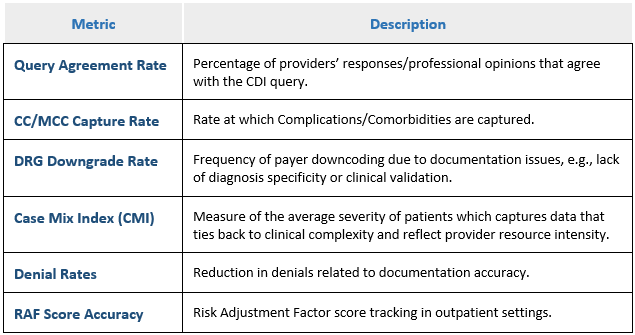
Key Metrics/Key Performance Indicators (KPIs) to Audit

To measure the success of a CDI program, organizations should track specific key performance indicators (KPIs):

CDI KPI

Conclusion 

Best practices for successful CDI audits involve the providers. After all – it is their documentation being audited! Ensure the CDI team creates processes that minimize administrative burden.

Leverage technology and streamline the audit process by using computer-assisted coding (CAC) and AI-powered analytics to scan for gaps and prioritize reviews. Ensure documentation is accurate across all patient encounters, not just for higher reimbursement.

Share feedback. Collaborate with the coding and billing departments to ensure documentation aligns with ICD-10/CPT guidelines. Create a closed feedback loop where findings are shared with clinicians and coders for ongoing training.

Remember, auditing for CDI is a continuous cycle of improvement, moving beyond simply chasing revenue to establishing a sustainable, compliant, and accurate record-keeping process. By focusing on regular reviews, actionable metrics, and ongoing education, organizations can improve the quality of clinical documentation, leading to better patient care and optimal financial outcomes.

About the Authors

Lorianne Maria Sainsbury-Wong, Esq., CISSP, CIPP/US, CHPC, is a member of the AIHC Volunteer Education Committee. Joanne Byron, BS, LPN, CCA, CHA, CHCO, CHBS, CHCM, CIFHA, CMDP, COCAS, CORCM, OHCC, ICDCT-CM/PCS, is the Chief Executive Officer at the American Institute of Healthcare Compliance.

References 

American Institute of Healthcare Compliance

National Library of Medicine

Office of Inspector General, U.S. Department of Health and Human Services. (2023). General Compliance Program Guidance.

Social Security Act § 1815(a), 42 U.S.C. § 1395g(a)

Social Security Act § 1862(a)(1)(A), 42 U.S.C. § 1395y(a)(1)(A)

Read More
Healthcare Revenue Cycle Compliance
Billing/RCM

Key Revenue Cycle Trends for 2022 and Beyond

Written by: Melvin Miller, COO


Tech, investments, efficiency, patient experience, underpayment recovery, and coding automation are some of the themes that will drive the revenue cycle market momentum in 2022 and beyond. Coming at the back-end of a long period of adversity due to COVID-19 and an already challenging economic environment for hospitals and healthcare systems, we see a new wave of consolidation, invention, and innovation. In this paper, we discuss some of the trends experienced in health care.


TIGHTENING PROFIT MARGINS – A PANDEMIC RAVAGED REVENUE CYCLE TO BOTTOM OUT.


With hospitals operating on extremely tight margins, projecting cash flow and the ability to extract the maximum out of the revenue cycle is more critical than ever before. This will drive key technology and process innovation as revenue cycle leaders and managers strive to improve business outcomes.


Now, let’s look at the broad trends in each of the major revenue cycle processes.


Patient Access and Experience


Patient experience is now one of the key issues impacting the healthcare industry. There is a huge information deficit in the area of patient payments.


Patients question “How much should I pay from my pocket?” The answer has been surprisingly difficult to find. Patients must get quick and easy access to information about services performed and corresponding charges; the amount expected to be paid by their insurance company; and the out-of-pocket expenses they are expected to bear. It is important to include the aspect of the No Surprises Act, which complicates the situation for both providers and patients.


We anticipate patient access and experience to improve with new technologies that can project the costs they need to bear, improved omnichannel information availability, and improved payment plans. Patient financial services will go through a much-needed overhaul.


Prior-Authorization and Eligibility Verification


While great tech exists for information interchange, prior authorization and eligibility verification tech adoption have lagged because of a lack of standardized documentation and information exchange protocols. With clearinghouses now modernizing, there is new hope for API-driven information exchanges.


Autonomous Coding


Automation tech is seeing increasing adoption, and there is a general perception that coding, billing, and accounts receivable problems will be solved through automation. Artificial Intelligence, Machine Learning, and Robotic Process Automation technologies provide great promise to lower labor costs. Medical coding is becoming data-driven and autonomous with improved standardization through ICD-11 and a better combination of virtual scribing, Universal Medical Language Systems (UMLS), OCR, and natural language processing (NLP). While these are still early days, coding tech is yet to prove effective in finding discharges not fully coded (DNFC) and arresting revenue leakage.


A/R, Denial Management, and Appeals Filing

Accounts Receivable (A/R) status has moved from calls to portals. We see increasing relevance for chatbots using conversational artificial intelligence (AI) in A/R and denial management filing. Data structures can now power customized appeals filing as well.

Focus on the Front-End

Most revenue cycle leaders agree that they need to solve revenue cycle issues in the front-end rather than elongate the cycle and wait to address them in the back end. They recognize that they need to link prior authorization, revenue integrity, clinical documentation improvement, and denial management to accelerate their revenue cycle. The ability to quickly identify denial issues, determine root causes, and develop solutions to reduce these denials through an iterative model that focuses on denial prevention is considered the key to addressing revenue cycle issues.

Underpayment and Analytics

The Hospital revenue cycle is fraught with underpayment issues. Contract analysis and underpayment identification can help arrest underpayments. As the shift to more branded, national healthcare practices happens, performance analytics becomes a critical business function. Practice-specific analytics using standard measures and Key Performance Indicators or KPIs will enable accurate views of performance and drive corrective action.

Unprecedented Financial Activity – Private Equity (PE), IPOs, Mega-mergers, and More

“It’s like Woodstock,” as some revenue cycle dealmakers are saying. The role of private equity in healthcare, in general, and the revenue cycle business, in particular, has increased to an unprecedented level.

  • Entry of the big boys. The big boys, i.e., the large PE firms have made strategic investments in revenue cycle assets.
  • Technology-led investments. Some of the themes that PE firms are investing in include focused revenue cycle service providers and niche technology companies such as autonomous coding, patient experience, prior authorization, and large-scale offshore providers.
  • Investments in revenue cycle aggregators. It seems like if a company’s resume says revenue cycle, it is likely to attract many valuations. Further, larger companies choose to hit the primary market through an initial public offering. We are seeing increasing consolidation of revenue cycle service providers as well.
  • Provider side consolidation. There is an increasing amount of investment in consolidation on the provider side. The push to provide a branded healthcare experience through nationwide chains is driving investments in areas such as urgent care, behavioral/mental health, wellness-focused treatments, home healthcare franchises, etc.

In 2022, we anticipate the continuance of these trends and mega-mergers will be more of a norm than an aberration.

Telehealth Adoption

Spurred on by the pandemic, telehealth adoption is increasing. Not only does this mean a lower cost of care, but it also requires the adoption of new processes for patient monitoring and managing the revenue cycle.

Remote Working

The COVID-19 necessitated revenue cycle team members to adopt work-from-home models. It also required operations managers to be flexible and adopt technologies to monitor revenue cycle performance. We anticipate that hospitals and healthcare systems will look at remote working as the new normal and encourage a significant percentage of their workforce to work remotely.

Labor Shortage and Outsourcing

There is an acute shortage of qualified revenue cycle staff. Many community hospitals are concerned about the community’s response to outsourcing and offshoring strategies they adopt. At this time of rising hospital expenses and reducing revenues due to declining reimbursements, outsourcing, offshoring, and automation can help them contain costs and sustain profitability. If using a U.S. based company that offshores the majority of their work, have you checked with legal counsel regarding how this type of business associate can be held accountable under U.S. laws (such as HIPAA, False Claims Act, etc.)

Conclusion

There has never been a better time to be in healthcare – and these are the most challenging times as well. Both in terms of economic activity and innovation, 2022 is likely to set a scorching pace. Whether you are a healthcare system, revenue cycle services provider, or technology solutions provider, this year will force you to think innovatively, build new delivery frameworks, and create the revenue cycle of the future.

Additional Resources:

_________________________________________________________

Melvin Miller is an experienced Chief Operating Officer with a demonstrated history of working in the healthcare industry for over 15 years, Satish, a.k.a. Melvin, has experience in team building, business development, Healthcare Information Technology (HIT), revenue cycle process training, US. Health Insurance Portability and Accountability Act (HIPAA), and Healthcare Management.
Read More