Healthcare Revenue Cycle Compliance
Billing/RCM

Best Practices in Patient Eligibility and Benefits Verification

Written by: Melvin Miller, Chief Operating Officer


With rising consumerism, patients have increasing responsibility for payments. The growth of high deductible health plans (HDHPs) is a clear indicator of this trend. It is, therefore, important to clearly understand the patient's responsibility for payments upfront and determine coverage.  


This article highlights the importance of patient eligibility and benefits verification.


What is patient eligibility and benefits verification?


A healthcare practice must verify a patient's coverage for medical services and determine their responsibility for payments. Through the patient eligibility and benefits verification process, physician practices can confirm the coverage offered by the health plan and copayments, deductibles, and co-insurance with the health plan. 


Verification of eligibility promotes the collection of the coverage status and reduces the likelihood of claims getting denied. It enables healthcare providers to collect payments from patients proactively and prevents delays in cash realization.


Information to be provided for patient eligibility and benefits verification


One of the fundamental components of the front-office tasks is to collect the patient details upfront and enable the verification of benefits by insurance verifiers.


Healthcare providers must train staff members on the insurance verification processes. Efficient processing reduces the likelihood of denials and accelerates the cash flow cycle.


Electronic and manual eligibility verification processes


Most payers have made available interfaces to check eligibility online. By verifying eligibility electronically before the scheduled patient appointment, you will be able to:

  • Get accurate information about the patient's insurance status and understand the benefits of the health plan.
  • Determine if you must collect a co-pay at the time of service.
  • Update insurance details.
  • Get patients to update primary care physician details.

Sometimes, it may be necessary to call the payer with questions related to prior authorization requirements or clarify some eligibility and benefits elements.


Timeliness of eligibility checks


Healthcare providers must check eligibility at least 48 hours before the visit. Should this not be possible, it can be done in real-time during check-in before the treatment. Timely eligibility checks help you reduce claim rejections and denials. Most electronic health records and revenue cycle management systems have electronic eligibility checking functionality. By verifying the patient's coverage before care delivery, your practice will be able to reduce denials and improve revenue realization.


Importance of process documentation


The needs of your practice are unique. A substance use support clinic has very different eligibility verification requirements from a hospital or radiology clinic. Hence, each institution must create specific eligibility and benefits verification workflows. All your team members need to collaborate effectively and ensure efficient completion of all steps.


Checklist for eligibility verification


The following are some of the best practices for the patient eligibility and benefits verification process.

  • Check if the plan is active.
  • Always quiz the patient about any impending or recent insurance changes.
  • Check if the patient has multiple insurances – primary, secondary and tertiary. Ensure that the patient has updated the Coordination of Benefits (COB) with each payer.
  • As a significant percentage of the population in the United States is aging, verify the Medicare coverage for patients who are above 65 years of age.
  • Understand if you need prior authorization or a referral for the specific medical service. If referrals or authorizations are needed, please obtain them and update the revenue cycle system.
  • Confirm if the patient's policy covers the procedure.
  • Some plans may stipulate the number of visits and time frame in which medical services can be delivered and have a ceiling on the benefit limits. The front office must obtain these details.
  • Specific services such as behavioral and mental health, substance abuse, and addiction may require a call to the insurance company. You may not be aware of these requirements and must refer to payer-specific guidelines.
  • Collect the payments for deductibles, copayments, and co-insurance based on the policy details. Pursuing patient collections can be tedious, and you must collect as much upfront as stipulated.
  • Collect additional information.

Social determinants of health are becoming an essential element of care delivery and promote healthcare equity and access. Characteristics such as race, gender, ethnicity, date of birth, preferred language, etc., are essential for Meaningful Use reporting. These characteristics are also crucial for health equity studies.


Outsourcing eligibility and benefits verification processes


An outsourced service provider can help you carry out eligibility and benefits verification processes. Their training processes help you get expert workers at reduced costs and reduce the workload on your revenue cycle team. Some of the benefits of outsourcing are:

  • Freeing up your staff's time to focus on other patient experience improvement and revenue cycle functions.
  • Speeding up time to care delivery.
  • Reducing denials and accelerated cash flow.
  • Reducing costs through labor rate arbitrage.
  • Well maintained policies and procedures.
  • Shifting the focus to denial prevention by reducing the number of eligibility and benefits related denials.

Eligibility and benefits verification company competencies


Efficient eligibility and benefits verification processes are essential for your organization's financial well-being. The process also accounts for the highest component of claim denials. You need to learn from each denial and constantly improve. Retain a company which can provide seasoned revenue cycle workers who can support your front-office staff with eligibility and benefits verification processes as well as comprehensive revenue cycle solutions to reduce costs and improve efficiency.


Additional Resources:

  • Medical Billing Wholesalers - https://www.medicalbillingwholesalers.com
    _________________________________________________________
    Melvin Miller is an experienced Chief Operating Officer with a demonstrated history of working in the healthcare industry for over 15 years, Satish, a.k.a. Melvin, has experience in team building, business development, Healthcare Information Technology (HIT), revenue cycle process training, US. Health Insurance Portability and Accountability Act (HIPAA), and Healthcare Management.
Read More
Healthcare Revenue Cycle Compliance
Billing/RCM

Addressing Revenue Cycle Labor Shortage With Technology and Outsourcing

Written by: Melvin Miller, COO


The labor shortage is currently one of the biggest issues across industries. Be it restaurants, hospitals, retail, hospitality, and manufacturing – take any sector and you will find that this is perhaps the #1 problem operations managers are facing.


In healthcare, the labor shortage is not limited to clinical roles but extends across administrative functions. Front-office staff, billers, coders, accounts receivable, denial management, and physician credentialing experts are in short supply.


If you look at the revenue cycle, lack of timely filing and follow-ups can increase denials and result in delayed cashflows. When your revenue cycle faces a staffing shortage for core functions, you tend to ignore the optimization functions such as quality assurance and underpayment reviews, which can unlock additional revenue opportunities.


The staffing shortage is aggravating problems for the hospitals, which were impacted already by the pandemic. Over the years, we have seen declining reimbursements necessitating revenue cycle operations to deliver the best financial outcomes, which requires deep healthcare and reimbursement process expertise.


With expert revenue cycle team members already in short supply and the mandate to get all employees vaccinated for COVID-19, hospitals and healthcare systems are losing employees due to resignations and terminations. Due to the shortage of clinical and non-clinical staff, many hospitals are on the verge of closing; in fact, many rural facilities have closed already. Further, the shortage has resulted in a fight for talent, which led to increased salaries and the cost of operations.


In this blog, we look at some of the strategies revenue cycle CFOs are deploying.

  • Cloud-based IT infrastructure

With the need to operate remotely, IT leaders are tasked with making mission-critical EHR and RCM platforms available anytime, anywhere. In most physician practices, the adoption of SaaS-based EMR/RCM solutions is increasing.

  • Process automation

Within both clinical and non-clinical revenue cycle solutions, the application of machine learning, AI, and RPA technologies are enabling revenue cycle leaders to combat the staffing shortage to some degree. Technology and automation can move routine, repeatable, labor-intensive tasks to the machines and reduce manual effort. For instance, claims status automation and the adoption of portals reduce call center workloads. When you free up people from mundane activities, they can focus on higher-value activities and have better job satisfaction.

  • Operational rigor

While all revenue cycle leaders talk about managing tighter operations, few have gone on to invest time and money in implementing workflow systems that help them measure, monitor, and manage the productivity of each employee. Transactional productivity improvements will, in the short term, lead to gains in financial outcomes.

  • Analytics for sustainable transformation

Usually, revenue cycle success boils down to strategic A/R management, i.e., understanding the patterns in denied claims, addressing root causes, strategic touches to claims in higher revenue brackets, and not allowing claims to fall into longer aging buckets. Revenue cycle analytics and adoption of industry-standard reporting can help RCM managers create the focus.

  • Outsourcing

Perhaps the #1 strategy that organizations are looking at is outsourcing, which gives them access to trained, certified labor across the nation. And with offshoring, you also get the benefits of cheaper cost structures. With the outsourcing and offshoring market now nearly two decades old, you can find service providers who have invested in process expertise and technology to help you get access to best-of-the-breed practices.

  • Optimizing costs to collect requires simultaneous implementation of pervasive change strategies

Across the revenue cycle operations, the questions that leaders need to ask are:


o What can you automate?


o What technologies do you need to invest in - workflow automation, analytics,
front-end tech?


o Where will you find the money to invest in new-age technology?


o Does this function need to be done onshore, or can you offshore it? 

  • Cash is king. Leaving revenue on the table is a crime.

Faster cash flow cycles are critical to the survival of healthcare organizations. Address the problems such as revenue leakage and front-end processes sustainably to streamline operations.

  • Change the job content for your employees

Accelerating the adoption of technology and outsourcing can shift the focus of your employees to strategic tasks. The change in job content makes them feel empowered to impact the organization’s revenue cycle outcome, which is more satisfying.

  • Don’t just outsource. Choose your vendor partner well.

Plan along with your vendors, transition and stabilize operations, and then move the goal post for the vendor every quarter.

While you can take the short-term to address your revenue cycle issues, it is time for revenue cycle leaders to implement sustainable solutions. The labor shortage is not going away quickly, and reimbursements will continue to decline. Technology, operational rigor, and outsourcing are the only options you have. Choose well, plan well, and execute in style.

Additional Resources:

  • Medical Billing Wholesalers - https://www.medicalbillingwholesalers.com

    _________________________________________________________

    Melvin Miller is an experienced Chief Operating Officer with a demonstrated history of working in the healthcare industry for over 15 years, Satish, a.k.a. Melvin, has experience in team building, business development, Healthcare Information Technology (HIT), revenue cycle process training, US. Health Insurance Portability and Accountability Act (HIPAA), and Healthcare Management.
Read More
Healthcare Revenue Cycle Compliance
Billing/RCM

Key Revenue Cycle Trends for 2022 and Beyond

Written by: Melvin Miller, COO


Tech, investments, efficiency, patient experience, underpayment recovery, and coding automation are some of the themes that will drive the revenue cycle market momentum in 2022 and beyond. Coming at the back-end of a long period of adversity due to COVID-19 and an already challenging economic environment for hospitals and healthcare systems, we see a new wave of consolidation, invention, and innovation. In this paper, we discuss some of the trends experienced in health care.


TIGHTENING PROFIT MARGINS – A PANDEMIC RAVAGED REVENUE CYCLE TO BOTTOM OUT.


With hospitals operating on extremely tight margins, projecting cash flow and the ability to extract the maximum out of the revenue cycle is more critical than ever before. This will drive key technology and process innovation as revenue cycle leaders and managers strive to improve business outcomes.


Now, let’s look at the broad trends in each of the major revenue cycle processes.


Patient Access and Experience


Patient experience is now one of the key issues impacting the healthcare industry. There is a huge information deficit in the area of patient payments.


Patients question “How much should I pay from my pocket?” The answer has been surprisingly difficult to find. Patients must get quick and easy access to information about services performed and corresponding charges; the amount expected to be paid by their insurance company; and the out-of-pocket expenses they are expected to bear. It is important to include the aspect of the No Surprises Act, which complicates the situation for both providers and patients.


We anticipate patient access and experience to improve with new technologies that can project the costs they need to bear, improved omnichannel information availability, and improved payment plans. Patient financial services will go through a much-needed overhaul.


Prior-Authorization and Eligibility Verification


While great tech exists for information interchange, prior authorization and eligibility verification tech adoption have lagged because of a lack of standardized documentation and information exchange protocols. With clearinghouses now modernizing, there is new hope for API-driven information exchanges.


Autonomous Coding


Automation tech is seeing increasing adoption, and there is a general perception that coding, billing, and accounts receivable problems will be solved through automation. Artificial Intelligence, Machine Learning, and Robotic Process Automation technologies provide great promise to lower labor costs. Medical coding is becoming data-driven and autonomous with improved standardization through ICD-11 and a better combination of virtual scribing, Universal Medical Language Systems (UMLS), OCR, and natural language processing (NLP). While these are still early days, coding tech is yet to prove effective in finding discharges not fully coded (DNFC) and arresting revenue leakage.


A/R, Denial Management, and Appeals Filing

Accounts Receivable (A/R) status has moved from calls to portals. We see increasing relevance for chatbots using conversational artificial intelligence (AI) in A/R and denial management filing. Data structures can now power customized appeals filing as well.

Focus on the Front-End

Most revenue cycle leaders agree that they need to solve revenue cycle issues in the front-end rather than elongate the cycle and wait to address them in the back end. They recognize that they need to link prior authorization, revenue integrity, clinical documentation improvement, and denial management to accelerate their revenue cycle. The ability to quickly identify denial issues, determine root causes, and develop solutions to reduce these denials through an iterative model that focuses on denial prevention is considered the key to addressing revenue cycle issues.

Underpayment and Analytics

The Hospital revenue cycle is fraught with underpayment issues. Contract analysis and underpayment identification can help arrest underpayments. As the shift to more branded, national healthcare practices happens, performance analytics becomes a critical business function. Practice-specific analytics using standard measures and Key Performance Indicators or KPIs will enable accurate views of performance and drive corrective action.

Unprecedented Financial Activity – Private Equity (PE), IPOs, Mega-mergers, and More

“It’s like Woodstock,” as some revenue cycle dealmakers are saying. The role of private equity in healthcare, in general, and the revenue cycle business, in particular, has increased to an unprecedented level.

  • Entry of the big boys. The big boys, i.e., the large PE firms have made strategic investments in revenue cycle assets.
  • Technology-led investments. Some of the themes that PE firms are investing in include focused revenue cycle service providers and niche technology companies such as autonomous coding, patient experience, prior authorization, and large-scale offshore providers.
  • Investments in revenue cycle aggregators. It seems like if a company’s resume says revenue cycle, it is likely to attract many valuations. Further, larger companies choose to hit the primary market through an initial public offering. We are seeing increasing consolidation of revenue cycle service providers as well.
  • Provider side consolidation. There is an increasing amount of investment in consolidation on the provider side. The push to provide a branded healthcare experience through nationwide chains is driving investments in areas such as urgent care, behavioral/mental health, wellness-focused treatments, home healthcare franchises, etc.

In 2022, we anticipate the continuance of these trends and mega-mergers will be more of a norm than an aberration.

Telehealth Adoption

Spurred on by the pandemic, telehealth adoption is increasing. Not only does this mean a lower cost of care, but it also requires the adoption of new processes for patient monitoring and managing the revenue cycle.

Remote Working

The COVID-19 necessitated revenue cycle team members to adopt work-from-home models. It also required operations managers to be flexible and adopt technologies to monitor revenue cycle performance. We anticipate that hospitals and healthcare systems will look at remote working as the new normal and encourage a significant percentage of their workforce to work remotely.

Labor Shortage and Outsourcing

There is an acute shortage of qualified revenue cycle staff. Many community hospitals are concerned about the community’s response to outsourcing and offshoring strategies they adopt. At this time of rising hospital expenses and reducing revenues due to declining reimbursements, outsourcing, offshoring, and automation can help them contain costs and sustain profitability. If using a U.S. based company that offshores the majority of their work, have you checked with legal counsel regarding how this type of business associate can be held accountable under U.S. laws (such as HIPAA, False Claims Act, etc.)

Conclusion

There has never been a better time to be in healthcare – and these are the most challenging times as well. Both in terms of economic activity and innovation, 2022 is likely to set a scorching pace. Whether you are a healthcare system, revenue cycle services provider, or technology solutions provider, this year will force you to think innovatively, build new delivery frameworks, and create the revenue cycle of the future.

Additional Resources:

_________________________________________________________

Melvin Miller is an experienced Chief Operating Officer with a demonstrated history of working in the healthcare industry for over 15 years, Satish, a.k.a. Melvin, has experience in team building, business development, Healthcare Information Technology (HIT), revenue cycle process training, US. Health Insurance Portability and Accountability Act (HIPAA), and Healthcare Management.
Read More
Auditing, Managing Denials Is Important to Good A/R Hygiene
Auditing

Part 3: Audit Documentation to Avoid Potential Appeal Consequences

Written by: AIHC Blogger


This article provides educational information related to mitigating the risk of an unwarranted payer investigation. Only appeal claims when you have evidence and supporting documentation to substantiate your right to payment. This is the final article in a 3-part series on denials and appeals management. Read Part 1 entitled “Managing Denials Is Important to Good A/R Hygiene” posted March 22, 2022, and Part 2 entitled “Understanding How Payers Deny Claims.”


Audit Coding, Billing and Documentation for Accuracy


Insurance carriers and government contractors have the authority to review any claims at any time. Due to the huge volume of claims payers receive to process, deny and pay, they have implemented various methods to track providers to detect potential waste, fraud and/or abuse.


Providers may take documentation “short cuts” or feel overwhelmed with implementation of a new EMR (electronic medical record) system and clone or make documentation errors. It is important to detect any problematic areas prior to filing an appeal. 


Lack of detailed supporting documentation submitted with an appeal can not only result in another denial, but also in “flagging” your practice as being high-risk on the spectrum of potential fraud and/or abuse. It can result in a situation where insurance opens an investigation or decides to initiate periodic audits on your claims and records. When you believe the payer is making the mistake, push back by exhausting all appeal rights allowed. If the payer, such as Medicare, performs an extrapolation, reducing each overpayment dollar through appeal can mean thousands less to pay back.


Utilize the information provided in the Part 2 article, such as ensuring the claim meets Medical Unlikely Edits, bundling, diagnosis and medical necessity guidelines. All modifiers should be appropriately appended and supported in the medical record. A great free modifier resource to share with you is the CMS Medicare Administrative Contractor (MAC) “WPS” learning center with on-demand training materials. Click here for the WPS modifier page (choose a region, the website will take you to the page).


Place of Service (POS) can be a “trigger” for an investigation. If the claim is coded POS 11 for the office, reimbursement can be higher than if the same service was performed at the hospital by the provider. Audit the POS to ensure this was coded correctly on the claim. A complete national POS code set and instructions are provided in CMS Internet-only Manual (IOM) Publication 100-04, Chapter 26, Section 10.5 at:  

https://www.cms.gov/regulations-and-guidance/guidance/manuals/downloads/clm104c26pdf.pdf


Is the date of service (DOS) correct? When the medical record date doesn’t match the date filed on the claim, you may have a difficult time arguing an appeal. Payers always require documentation for the date of service filed (and paid) on the claim. When the DOS is incorrect, accept the denial. If you have not passed the timely filing deadline, re-file the claim with the correct DOS.


Audit to ensure your organization has no excluded individuals employed


An example of a case settled in 2022 is Windham Eye Group, an ophthalmology practice paying $192,000 for employing an excluded practice administrator. Please make sure your organization routinely screens employees to ensure none are on the OIG exclusions list. Prior to appealing a Medicare, Medicaid, TriCare or other Federal Program claim, you should verify that your organization is compliant in this area (click here). 


Evidence of Medical Necessity


Medical necessity includes frequency, duration, previous conservative treatment (that failed) and other factors. However, it also includes documentation of a supporting diagnosis.


The diagnosis coding on the claim is one of the first items insurance will review to qualify the claim as being “medically necessary.” Once the diagnosis coding passes through the insurance company edits, additional edits will then be performed against medical necessity criteria. 


Diagnosis codes are an important compliance aspect of reporting medical necessity on the claim. They are also a large contributing factor for potential fraud and abuse when documentation does not support the diagnoses reported. Auditing the diagnoses on the claim to documentation is a critical review step to determine whether the claim should be appealed.

  • Diagnoses should be sequenced according to coding guidelines.
  • Each line-item on the claim should be linked to the appropriate procedure code.
  • Audit the code to ensure all characters are accurate.
  • Each condition reported on the claim must be documented in the patient’s chart.
  • Verify that the primary diagnosis is listed as “medically necessary” for the treatment provided.

Detect a Problem?


During the course of auditing or reviewing documents related to a denied claim, you may identify situations where further investigation is necessary. You may state it is simply a billing error. Errors made over and over in high volume or high dollar amounts will be interpreted as more than a simple billing mistake by payers. 

  • Make careful consideration before appealing denials found on an investigational probe. 

Obtaining legal advice before proceeding with an appeal may be necessary under certain circumstances. 


Carrier SIU Situations


Insurance carriers have departments called Special Investigation Units or “SIU” with trained professionals carefully reviewing allegations of suspected fraud and abuse. 


When a probe or investigation is initiated by a payer in writing or in-person, it is likely the investigators have already been speaking with your billing staff and patients to gather information to establish a case against you.


Can the investigators “get it wrong”?  They can, sometimes!


There are times when investigators believe the situation is intentional (fraud) when the problem actually is being caused by lack of internal controls, auditing and monitoring by the provider. This allows errors to continue for prolonged periods of time.  


When your office receives the results of the SIU (carriers) probe, the letter will provide guidance regarding ability to appeal. If you are given the option to appeal, have evidence of a strong argument to support that these claims should be paid. If you can’t meet the deadline to appeal, request an extension to buy more time to audit and properly prepare your appeal argument. 


If your organization has a Compliance Officer and/or Certified Healthcare Auditor, you may want to bring concerning situations to his/her attention. Never file an appeal when you believe documentation may be evidence of fraud or abuse. You may need assistance from someone more highly trained in this area to determine this. If in doubt, check it out.


When speaking with your provider, Compliance Officer, Auditor or an attorney, the “short” list of rules and regulations which apply to medical coding, documentation and billing are listed below. 

  • False Claims Act (FCA);
  • Anti-Kickback Statute (AKS);
  • Physician Self-Referral Law (Stark Law);
  • Social Security Act; and
  • United States Criminal Code.

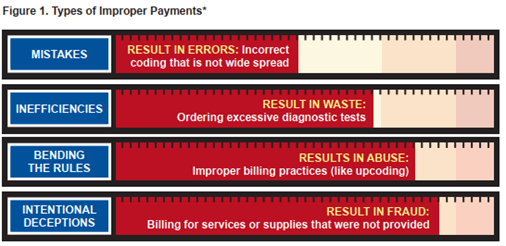
The difference between “fraud” and “abuse” depends on specific facts, circumstances, intent, and knowledge. Examples of abuse can include such things as:

  • Billing for unnecessary medical services (lack of medical necessity);
  • Charging excessively for services or supplies;
  • Misusing codes on a claim, such as upcoding or unbundling codes;

According to the Medicare Integrity Program, activities which target various causes of improper payments are items such as those in the chart below.


The government's primary civil tool for addressing healthcare fraud is the False Claims Act (FCA).

  • Most FCA cases are resolved through settlement agreements in which the government alleges fraudulent conduct and the settling parties do not admit liability.
  • Based on the information it gathers in a FCA case, the Office of Inspector General (OIG) assesses the future trustworthiness of the settling parties (which can be individuals or entities) for purposes of deciding whether to exclude them from the Federal healthcare programs or take other action.

The OIG's efforts to curb fraud include:

  • Conducting criminal, civil, and administrative investigations of fraud and misconduct related to HHS programs, operations and beneficiaries;
  • Using state-of-the-art tools and technology in investigations and audits around the country;
  • Imposing program exclusions and civil monetary penalties on health care providers because of criminal conduct such as fraud or other wrongdoing;
  • Negotiating global settlements in cases arising under the civil False Claims Act, developing and monitoring corporate integrity agreements, and developing compliance program guidance.

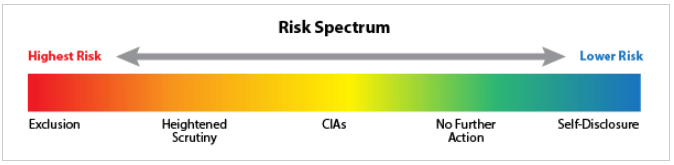
Because OIG's assessment of the risk posed by a FCA defendant may be relevant to various stakeholders, including patients, family members, and healthcare industry professionals, the OIG makes information public about where a FCA defendant falls on the risk spectrum.


The five risk categories on the spectrum are defined below:


Highest Risk:  Exclusion

  • Parties that OIG determines present the highest risk of fraud will be excluded from Federal healthcare programs to protect those programs and their beneficiaries. Excluded individuals and entities are listed in OIG's Exclusions Database.

High-Risk:  Heightened Scrutiny

  • Parties are in the High-Risk category because they pose a significant risk to Federal healthcare programs and beneficiaries. This is because, although OIG determined that these parties needed additional oversight, they refused to enter Corporate Integrity Agreements (CIAs) sufficient to protect Federal healthcare programs. Parties in the High-Risk category that reached settlements since on October 1, 2018, or later are listed here.

Medium risk:  CIAs or Corporate Integrity Agreements

  • Healthcare providers and other entities in the Medium Risk category have signed CIAs with OIG to settle investigations involving Federal healthcare programs. Under these agreements, parties promise to fulfill various obligations in exchange for continuing to participate in the programs.

Lower Risk:  No Further Action

  • The OIG sometimes concludes that parties present a relatively low risk to Federal healthcare programs. As a result, OIG is not seeking to exclude them from those programs or require a CIA. OIG's cases against these parties are closed without evaluating the effectiveness of any efforts the parties have made to ensure future compliance with Federal healthcare program requirements.

Low Risk:  Self-Disclosure

  • A party may disclose evidence of potential fraud related to Federal healthcare programs to OIG. The OIG believes that doing so in good faith and cooperating with OIG's review and resolution process generally demonstrates that the party has an effective compliance program. OIG works to resolve such cases faster, for lower settlement amounts, and with a release from potential exclusion with no CIA or other requirements. More information about OIG's self-disclosure protocol – click here.

This ends Part 3 for the denials and appeals article series. There is so much more to share with you, however, as you can see, filing an appeal involves various considerations and skill sets. Register, train and certify in Appeals Management - Online, On-Demand! 


Read More
Healthcare Revenue Cycle Compliance
Billing/RCM

Part 2: Understanding How Payers Deny Claims

Written by: AIHC Blogger


This article provides educational information related to fighting unreasonable denials by working through a complex payer appeals process. This information is not all-inclusive and the article is a truncated version of Lesson 3 from our Certified Outpatient Clinical Appeals Specialist (COCASSM) training program. The complex Medicare appeals process is used to demonstrate the importance of appealing claims denied in an audit. Make sure to read Part 1: Managing Denials is Important to Good A/R Hygiene.


Audited by a payer?  


Is your organization under a payer audit? Fight back by appealing unreasonable denials. But first, learn more about how a complex payer audit system works. 


Understanding how a payer reviews and makes a payment determination will strengthen your ability to argue and defend your claim upon appeal. The learning objective of this lesson is to help you become familiar with the Medicare Claims Review Program (MCRP). This program monitors inappropriate payments. Other payers mirror Medicare’s program.


What is an “improper” payment?


These are reimbursements that should not have been made or that were made in incorrect amounts. According to the U.S. Government Accountability Office (GAO), improper payments have been estimated to total almost $1.7 trillion government-wide from fiscal years 2003 through 2019. Auditing and denying claims after the claims have been paid is “big money” for the government. 

  • For example, the GAO states that they identified about $77.6 billion in financial benefits in fiscal year 2020—a return of about $114 for every $1 invested.
  • They also identified 1,332 other benefits that led to program and operational improvements across the government.
  • Most recently, GAO has been evaluating the largest response to a national emergency in US history, the $2.6 trillion COVID-19 response legislation, and making recommendations about how to improve its effectiveness in dealing with public health issues and the economy.

The Medicare Fee-for-Service Compliance programs prevent, reduce, and measure improper payments in FFS Medicare through medical review. A number of programs are provided to educate and support Medicare providers in understanding and applying Medicare FFS policies while reducing provider burden.


A Medicare contractor may use any relevant information they deem necessary to make a prepayment or post-payment claim review determination. This includes any documentation submitted with the claim or through an additional documentation request.


CMS' Center for Program Integrity (CPI) oversees Medicare medical review contractors. CPI conducts contractor oversight activities such as:

  • Providing broad direction on medical review policy
  • Reviewing and approving Medicare contractors' annual medical review strategies
  • Facilitating Medicare contractors' implementation of recently enacted Medicare legislation
  • Facilitating compliance with current regulations
  • Ensuring Medicare contractors' performance of CMS operating instructions
  • Conducting continuous monitoring and evaluation of Medicare Contractors' performance in accord with CMS program instructions as well as contractors' strategies and goals
  • Providing ongoing feedback and consultation to contractors regarding Medicare program and medical review issues

The Medicare Claims Review Program, or “MCRP,” involves both technical and clinical categories of denials performed by CMS contractors. It is a complex system, perfect to use as a teaching example! There are two categories of denials:


1. Technical Denial & Rejection
     • This topic has been covered in previous lessons, but let’s review again!

o A technical denial is an error made when filing the claim, such as lack of appropriate coordination of benefits and filing to secondary insurance first. When a critical error gets through the scrubber, the insurance payer software may reject the claim due an error. Correcting these types of errors quickly and refiling the claim typically results in payment. These claims often “fall through the cracks” and can be suspended. Lack of tending to rejected claims can cause huge revenue loss for your organization.


2. Clinical Denial
    • A clinical denial is the denial of payment by an insurance payor on the basis of medical necessity, length of stay or level of care. Special review of documentation, payer guidelines and often appealing the claim is required to obtain payment.

o When a payer sends an RFI (Request for Information), the payer is auditing the claim data against medical record documentation.
o Untimely response to the RFI will result in a denial.
o Sending inappropriate or wrong information to the payer will result in a denial.
o These types of denials can potentially trigger a larger audit, a probe, or an abuse or fraud investigation of your organization


CMS estimates the Medicare FFS improper payment rate through the Comprehensive Error Rate Testing (CERT) program. Each year, the CERT program reviews a statistically valid stratified random sample of Medicare FFS claims to determine if they were paid properly under Medicare coverage, coding, and payment rules.


Audits or claim reviews are conducted either prepayment or post-payment of the claim and typically fall under one of these categories:

  • Compliance to bundling edits (Medicare’s National Correct Coding Initiative or NCCI Edits)
  • Medically Unlikely Edits or “MUEs”
  • Comprehensive Error Rate Testing (CERT)
  • Recovery Audit Program
  • Medical Reviews (MRs)

National Correct Coding Initiative (NCCI) Edits


CMS developed the National Correct Coding Initiative (NCCI) to promote national correct coding methodologies and to control improper coding leading to inappropriate payment in Part B claims. The Centers for Medicare & Medicaid Services (CMS) owns the NCCI program and is responsible for all decisions regarding its contents.


Most payers either use the NCCI edits or have a similar bundling edit system in place. Basically, bundling edits review codes on a claim to determine whether the items can be filed and paid separately or bundled into one code.


The claims scrubber software within your practice management system will analyze the codes on the claim and compare the information to the NCCI edits. Items that should be bundled will be suspended for further review. Your office cannot bill a patient for a service denied due to denied claims based on the NCCI edits.


These edits are updated at least quarterly and revised in your practice management system through updates to the software. Information about the National Correct Coding Initiative (NCCI) can be found in the Internet-Only Manual, Publication 100-04, Section 20.9 of Chapter 23 of the Medicare Claims Processing Manual.


When appealing NCCI edit denials, it is important to review the claim to ensure the appropriate modifier has been used. If not, review the documentation and appropriately append the modifier to the line item on the claim and submit your appeal with the documentation. 


Modifiers allowed with the National Correct Coding Initiative (NCCI) procedure to procedure (PTP) edit that can be used under appropriate clinical circumstances to bypass an NCCI PTP edit include:

  • Anatomic modifiers: E1-E4, FA, F1-F9, TA, T1-T9, LT, RT, LC, LD, RC, LM, RI
  • Global surgery modifiers: 24, 25, 57, 58, 78, 79
  • Other modifiers: 27, 59, 91, XE, XS, XP, XU

NOTE:  Overuse of such modifiers just to get claims passed through the edits for payment can trigger an audit, probe or investigation. 


Medically Unlikely Edit (MUE)


This audit feature analyzes a claim to determine if the appropriate number of units are being reported per line item. It is a unit of service edit for a Healthcare Common Procedure Coding System (HCPCS)/Current Procedural Terminology (CPT) code for services rendered by a single provider/supplier to a single beneficiary on the same date of service (DOS).


The ideal MUE is the maximum unit of service that would be reported for a HCPCS/CPT code on the vast majority of appropriately reported claims. 


MUEs are designed to reduce errors due to clerical entries and incorrect coding. MUEs are adjudicated either as claim line edits or DOS edits.

  • If the MUE is a claim line edit, each line of a claim is adjudicated against the MUE value for the Healthcare Common Procedure Coding System (HCPCS)/Current Procedural Terminology (CPT) code on that claim line.
  • If the UOS on the claim line exceeds the MUE value, all UOS for that claim line are denied. If the same code is reported on more than one line of a claim by using CPT modifiers, each line of the claim is adjudicated separately against the MUE value of the code on that claim line.

For Medically Unlikely Edits (MUEs) that are adjudicated as claim line edits, each line of a claim is adjudicated separately against the MUE value for the code on that line. The appropriate use of Healthcare Common Procedure Coding System (HCPCS)/Current Procedural Terminology (CPT) modifiers to report the same code on separate lines of a claim will enable a provider/supplier to report medically reasonable and necessary UOS in excess of an MUE value.


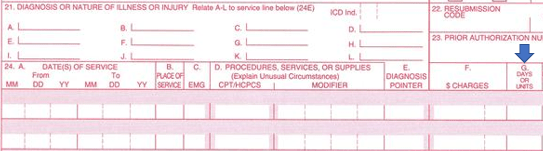
24.G is the field on the 1500 claim being audited for MUE compliance:


These edits are updated at least quarterly and revised in your practice management system through updates to the software. 


Comprehensive Error Rate Testing (CERT) Program


CERT contractors perform a complex medical review of the claim and the supporting documentation to determine whether the claim was paid appropriately according to Medicare coverage, payment, coding, and billing rules.


CMS calculates a national Medicare Fee-For-Service (FFS) improper payment rate and improper payment rates by service type to accurately measure the performance of the MACs and gain insight into the causes of errors. CMS publishes the results of these reviews annually.


The Medicare FFS Improper Payment Rate is a good indicator of how claim errors in the Medicare FFS Program impact the Medicare Trust Fund. CERT errors are listed by the following categories:


The Recovery Audit Program


Most hospitals and clinics are familiar with the “RAC” or Recovery Audit Contractor program – now referred to as the “Recovery Audit Program” by CMS.


RAC's review claims on a post-payment basis by auditing past Medicare FFS claim data for potential overpayments or underpayments and reviewing medical records when necessary to make appropriate determinations. When performing these reviews, Recovery Auditors follow Medicare regulations, billing instructions, National Coverage Determinations (NCDs), coverage provisions, and the respective MAC’s Local Coverage Determinations (LCDs). Recovery Auditors do not develop or apply their own coverage, payment, or billing policies.


In general, Recovery Auditors do not review a claim previously reviewed by another entity. Recovery Auditors analyze claim data using their proprietary software to identify claims that clearly or likely contain improper payments.


Medical Review Audits


Medical reviews identify errors through claims analysis and/or medical record review activities. Contractors use this information to help ensure they provide proper Medicare payments (and recover any improper payments if the claim was already paid). Contractors also provide education to help ensure future compliance.


A Medicare contractor may use any relevant information they deem necessary to make a prepayment or post-payment claim review determination. This includes any documentation submitted with the claim or through an additional documentation request. 


One of the first items reviewed is a valid authentication or signature. Next, auditors typically review documentation for medical necessity; information to support units, laterality, diagnosis coding and supporting documentation such as signed orders or plan of care.


Learn more about clean claims, prompt pay laws, fighting denials based on medical necessity, appealing ERISA denials, the Medicare appeals process, and how to create an effective denials and appeals program – click here and become an Outpatient Clinical Appeals Specialist. Click Here to see if we have any upcoming classroom training camps!

Read More
Healthcare Revenue Cycle Compliance
Billing/RCM

Part 1: Managing Denials Is Important to Good A/R Hygiene

Written by: AIHC Blogger


Too many denied claims to manage? Practicing good revenue cycle management “hygiene” is important – but most don’t know where to start.


This article provides a basic overview of the importance of improving your appeals process to get denials overturned as it relates to overall revenue cycle management. This information is not all-inclusive and is for educational purposes only. We recommend formal training in denials and appeals management and encourage medical billing companies and practice managers gain better insight into accounts receivable (A/R) management through online training and certification.


Revenue cycle management includes tracking claims, making sure payment is received, and following up on denied claims to maximize revenue generation. Several metrics can help you determine whether your revenue management cycle processes are efficient and effective. The first metric is days in accounts receivable (A/R). Days in A/R refers to the average number of days it takes a practice to collect payments due. The lower the number, the faster the practice is obtaining payment, on average.


When a large number of denials are due to a single payer and in a short amount of time, conduct analysis of the situation quickly. Why? This could be an investigation initiated by the payer and may warrant additional assistance to evaluate. You need to know there is a problem and understand the underlying cause before you can resolve it.


According to the American Academy of Family Physicians (AAFP), a 5% to 10% denial rate is the industry average, but keeping the denial rate below 5% is more desirable. Automated processes can help ensure your practice has lower denial rates and healthy cash flow. For most practices, days in A/R should stay below 50 days at minimum; however, 30 to 40 days is preferable and achievable when your revenue cycle team works smart!


Know Your “Days in A/R”


When claims are filed but not paid, days in accounts receivable (A/R) will be higher than your internal historical benchmarks and likely higher than the industry standard for your type of specialty or practice. High days in A/R, or when receivables older than 120 days is greater than 12%, should trigger a signal that improvement is needed – fast! Most of the time improvement in the appeals process is required to avoid writing-off denied claims.


To get the most accurate picture of your practice’s financial standing, base your calculations on the actual age of the claim, i.e., the date of service, not the date on which the claim was filed or when it changes hands from one financially responsible party to another (primary insurance to secondary insurance; insurance to patient). This may mean contacting your vendor to adjust settings in your practice management system to create more meaningful A/R management reports.


How often does your Revenue Cycle Manager (RCM) run a credit balance report? Reconciling accounts with credit balances is the first step toward achieving maximum A/R hygiene. Credit balances are often a neglected aspect of the revenue cycle that can have serious negative effects. Credit balances left unattended can very quickly accumulate to a volume that impacts your accounts receivable reporting and may put your facility at risk for violating federal regulations or your insurance contracts. If your accounts receivable (A/R) reports include credit balances, your A/R will appear better than it actually is as the credits will offset balances due.


Next, calculate the practice’s average daily charges. Add all of the charges posted for a given period (e.g., 3 months, 6 months, 12 months). Then, subtract all credits received from the total number of charges. Next, divide the total charges, less credits received, by the total number of days in the selected period (e.g., 30 days, 90 days, 120 days, etc.). Next, calculate the days in A/R by dividing the total receivables by the average daily charges.


Review Aging Reports


Calculate A/R greater than 120 days using the oldest “buckets” in your aging report to determine how much and from what payers remains unpaid from the date of service to now. To calculate, divide the dollar amount of accounts receivable that is greater than 120 days by the dollar amount of total current accounts receivable, then multiply by 100.


Monitor Reports for Inappropriate Write-Offs


Are accounts reconciled and overpayments identified and handled properly? After careful review, are there adjustments made to accounts that have no paper trail or explanation posted on the account? Are there mistakes made with auto (or manual) posting of contractual adjustments? When your practice fails to distinguish between noncontractual adjustments and contractual adjustments, results may provide a misleading view of how well your practice collects the money it has earned. It can also be a sign of potential embezzlement. Categorizing noncontractual adjustments (e.g., “untimely claims filing” or “failure to obtain prior authorizations”), will help reveal sources of errors and identify opportunities to improve revenue cycle performance.


Managing the issues listed above should come first. Then, move on to calculating and improving your denial rate.


Know Your Claims Denial Rate


The denial rate represents the percentage of claims denied by payers during a given period. This metric quantifies the effectiveness of your revenue cycle management processes. A low denial rate indicates cash flow is healthy and fewer staff members are needed to maintain that cash flow.


A 5% to 10% denial rate is the industry average; keeping the denial rate below 5% is more desirable. Automated processes can help ensure your practice has lower denial rates and healthy cash flow.


To calculate your practice’s denial rate, add the total dollar amount of claims denied by payers within a given period and divide by the total dollar amount of claims submitted within the given period.


The lower the denial rate, the fewer revenue cycle workforce members are needed to manage receivables.


Analyze Denials Data


Root cause analysis or RCA may be helpful for your organization to avoid the “band aid” approach and resolve underlying contributing factors, such as inaccurate coding, documentation and/or billing practices. Revenue Cycle Managers are encouraged to obtain some training in compliance auditing. A good program should include basics in RCA and statistical analysis.


Use the Pareto Principle – the “80/20 Rule” to get organized and maximize revenue!


The 80/20 Rule means that in anything, a few (20 percent) are vital and many (80 percent) are trivial. Project Managers know that 20 percent of the work (the first 10 percent and the last 10 percent) consume 80 percent of your time and resources. You can apply the 80/20 Rule to almost anything, from the science of management to the physical world. The value of the Pareto Principle for a manager is that it reminds you to focus on the 20 percent that matters.


According to the Pareto Principle, of the things achieved during your day, only 20 percent really matter. Those 20 percent produce 80 percent of your results. Identify and focus on those things.


Don't just "work smart," work smart on the right things. It applies to denials management as follows:


The insurance companies you bill most – the top 20 percent of your payers are likely to contribute 80% of all insurance revenue. Focus on denials of those top 20 percent when starting your push-back appeals management program.

  • Take the denials representing those top payers; you are likely to find that 20 percent of those claims constitute 80 percent of the total dollar amount represented in the denial “stack.” Focus on those first.
  • Working the most commonly denied claims representing the higher dollar amounts FIRST with the objective of appealing before the deadline must be your goal.
  • If you must write-off denied claim balances in your system due to passing the appeal deadline, let it be the lower dollar amounts from payers you do not file frequently. This is not to say that these denials are less important, but decisions need to be made where to place energy and focus when resources are limited.
  • Track the amount or volume of write-off adjustments to request additional resources when warranted.

Be persistent, follow through and don’t back down when you know payment from insurance is warranted. Always keep track of problematic areas by payer. Create quarterly reports to analyze the number and type of denials per payer to check for “trends.” Meet with your provider relations representative, when possible, to discuss problem areas. Do not be afraid to take the appeal to the highest level allowed. Make your point with the insurance company in a professional manner. Be persistent and never back down when you know you are right.  


Remember:  An effective appeals management program, over time, will require fewer resources because the insurance companies are denying fewer claims. 


Learn more about clean claims, prompt pay laws, fighting denials based on medical necessity, appealing ERISA denials, the Medicare appeals process, and how to create an effective denials and appeals program – click here and become an Outpatient Clinical Appeals Specialist. Click Here to see if we have any upcoming classroom training camps!

Read More
Auditing, Managing Denials Is Important to Good A/R Hygiene
Auditing

Wrestling the Dragon

Avoiding Medical Denials When the Problem is Elusive


Written by Carl J Byron, CCS, CHA, CIFHA, CMDP, CPC, CRAS, ICDCTCM/PCS, OHCC and CPT/03 USAR FA (Ret)


In the first part of this series, we looked at a young patient in their early 20s who, in spite of 24- hour care by multiple specialties, died and all claims were denied in their entirety.

In this new case, we have a long-term inpatient who was attacked by an exotic animal a friend was keeping “as a pet.” Almost every specialty is called in on the case and the inpatient stay lasts well over a year. But during that time, after about 3 weeks of visits, Infectious Disease doctors stop billing for their services. They are worried with what little they have to go on that their claims will be denied out of hand “anyway.” They know the episode (the entire hospital stay once the patient is finally released) will be reimbursed on a limited basis and they would rather the payments go to the doctors with more detailed codes. For nine months, not one claim is filed. As you would expect, especially if you have seen any exotic animal attack cases that made the news, the damage to the victim’s body was immense and multiple large surgeries were required.

This time, the dragon is facing us and ready to charge. We don’t have to chase it, we know the problem. We have to wrestle it. We have to bring enormous complexity to a patient stay that has so many aspects, details and nuances that the argument for submitting the claims and getting paid is difficult because the patient’s condition is so poor the insurance company will have difficulty understanding all of the medical complexities. This is somewhat different than a pre-payment audit because the claims have not yet been completed. Infectious Disease (ID) providers, with decades of experience, are reluctant to file claims because of fear of denials and, by extension, accusations of fraud. Again, we are dealing with a problem. Although it is physically obvious, it is not so clear when reduced to codes which fall far short of the extent of the providers’ work to save the patient. The payor guidelines are equivocal and do not address a unique situation like this. But there is a statement that the medical decision making and clinical reasoning of the providers for any patient will be given primary weight. This is critical. Unless I can find something unique, the ID providers are stuck with only three procedure codes: 99231, 99232, and 99233. Not much room to maneuver.

My manager assigns me all of the ID claims and asks me to conduct a 100% records audit for the nine months. As in Part 1 of this series, the first thing I do is look at the progress notes. Due to the sheer volume, I determine (1) how many encounters there are total; (2) what would be a statistically significant sample number and then pull encounters from random dates throughout the hospital stay. Now the real work starts.

The first thing that strikes me is the enormous amount of damage done to the patient’s body. From the documentation alone, I could tell the damage was beyond anything I had ever seen. Extremely deep scratches were documented as well as punctures from fangs that tore through skin, muscle and tendon and literally shredded bones. Dislocated joints from being grabbed and pulled so hard the body could not tolerate the shearing forces. Grafts as well as vascular and orthopaedic repairs have to be done in “bouts” throughout the stay because the damage is so comprehensive the repairs cannot be done at one surgical visit. This is critical because it tells me even with gauze, coverings, etc., the patient’s underlying skin, muscle, tendons, blood vessels, lungs and even heart are in serious jeopardy of infection. A note was made and I proceeded from there. Inference tells me that, with so many surgeries completed and yet to be done, much of this patient’s skin and underlying structures are now open, even with the best suturing on the planet and antibiotics. Inference further tells me so many grafts present an infection potential of their own. Think of a paper cut: painful, obstinate, those things just don’t want to heal. Now, take that cut and make it into a long tear down to the bone and imagine 75%+ of your body area being torn, bitten, scratched or surgically open like that. You might get about a 5% picture of this patient’s daily situation. Just “maintenance” required a Herculean effort.

There are times when an auditor needs to let the inferences guide the direction of the audit, at least in part. Such was the case here, both with the documentation and with photos, and I will clarify it shortly. The next step, and I will admit I could be accused of changing my random audit to a targeted one, I looked for all the encounter dates I could find with photographs and x-rays. The photos were pretty gruesome but they displayed a very important fact: the opportunity for infection was always dangerously high. So, my first argument was made for me. Even if all ID did was maintain this patient, it was a serious accomplishment. It is said a picture speaks a thousand words. Those, coupled with the documentation, made an ironclad argument and I already knew we had a good chance.

As in Part 1, when I had assembled my audit structure and determined how I would proceed, I looked at every progress note. Then, I looked at every non-infectious disease progress note and another point showed itself: almost every note I read, referenced either reviewing the last ID note or speaking with the ID provider on service that day. Their evaluation on any given day was sought out even if it did not change from the previous day(s). So, as in Part 1, I contacted the providers. Again, they all agreed to meet but, due to the volume of work they did, they asked to include the Department Chair so he could fill in any blanks and keep me focused on ID-specific issues.

The meeting was eye opening. First, I let my inferences guide the opening of the meeting. If the damage to the patient was so massive, then perhaps smaller details existed to show the work these doctors and non-physician providers did. So I asked about how these providers dealt with labs. Turns out they almost lived in the laboratory; they relied on so many tests. The damage was so extensive that infection may not have been obvious on observation and the trauma to the skin went so deep the ID physicians needed lab tests to guide them every day. This is additional work and another argument when the claims are filed. Then came the biggest surprise, and the best details I may have overlooked if I had relied solely on the notes.

The providers started by telling me about how the deep bites, scratches, punches and open shearing wounds could cause infection in different ways, and even different infections. But these physicians were unfamiliar with many exotic animals and they had to make international calls to other countries’ zoos, biologists, veterinarians and animal experts to get help and advice treating this patient. These calls were made almost daily throughout the patient’s stay. But if information did not change, the providers only made a short notation in the progress note which could easily be overlooked.

Then, they took the photos and x-rays I brought with me and explained what they saw, what the photos meant, and how they drove their decisions at any given visit. They segregated specific labs and showed me what they looked for and why, in their medical judgment, so many had to be run. This was news indeed and the way the providers put it gave a detailed report I never could have arrived at without their assistance. As I mentioned earlier, other providers relied on their findings to determine how to proceed. This was also the case with the ID providers and they were in continuous contact with vascular surgery, orthopaedic surgery and especially reconstructive surgery and dermatology. The ID providers concluded by telling me that although the notes looked like maintenance-only treatment, because of the critical damage done to the patient/victim, they had to proceed with considerable caution because they were not the only specialty on this patient’s case. Every specialty had to make certain (as much as possible) that no other provider was negatively impacted by anything another provider did. This was an extreme learning experience for all of them.

Armed with this information, the only real difficulty I faced was putting the argument for payment together coherently and precisely. Every detail I could have wished for was in place. My manager allotted plenty of time but we were talking about nine months of claims for every day of the week. So my last possible hurdle was removed, thanks to a manager who wanted an accurate, complete audit. She reassigned my secondary duties to others on our team, even taking some herself. It was time to sprint to the finish line.

First, I printed a copy of the insurance company’s guidelines and where there were blanks (especially with inference) I pulled CMS guidelines. CMS allows inference if it can be clearly determined. This, coupled with the insurer’s statement that medical decision making of the provider will be given the most weight, made clinical medical necessity my focus rather than payor guidelines. As in Part 1, I still had to argue two types of medical necessity: why the doctors believed the patient needed treatment and did the treatments fall within the insurer’s guidelines.

Inference had shown me immediately that the damage and trauma to the patient was life-threatening. Inference from ID running so many labs was that the providers were either investigating something or making certain something was not showing up. Inferences from the documentation led me to know I had to get copies of all photos, x-rays and other very specialized procedures. When I did, the picture was so clear even a non-medically educated person could see this was an exceptional case. It also showed me how I needed to approach the most important medical necessity argument: why the providers did what they did, every day, every week, every month. With the information gained from meeting with the providers, every aspect of this specialty’s patient care became clear: the medical reasoning, the timing of procedures, everything. This is the value of inference and I never do an audit without it as a guideline.

The first was admittedly fairly easy. The risk of infection was so high that hour by hour oversight was critical to the ID providers and they not only had to prevent infection but they had to be ready to attack an infection from an exotic animal that the American medical field knew little about. Here is where I entered the evidence of so many international calls and constant consultations with other specialties involved. Then, I stated how after every surgery, and every surgery was major, the patient had to be cut open again. Next, came the extensive lab work and direct quotes from the meeting I had with the providers. Then, I tied it all together and made the photographs, x-rays, labs and other concurrent treatments separate exhibits. The photos especially were unnerving and separating them made them even more effective. Explaining what the doctors saw from the labs, x-rays, etc., and referencing them in a separate exhibit I believed also made them easier to find. This “pre-appeal” was going to be BIG. I completed my argument with information I gained at the meeting that I believed would be helpful.

Now for the codes. For the diagnoses, as with the examples in Part 1, they were not very specific and it could be assumed the payor would balk. I called the ID department chair back and asked him if he would be willing to have all of his staff involved (which was the entire department, as it turned out) review a few notes and give me some ideas. I had them within a couple of days. Since much of the treatment was prophylactic, meaning trying to keep infection from occurring, I reiterated the extent of the damage and specific statements made at our meeting. This showed the constant threat of infection and how, due to the mechanism of injury, it was not a well-known threat potential. I also used as many post-surgery and open wounds codes as I could because any area open to the air was a primary infection entrance point. Therefore, what might be misconstrued as maintenance was in fact treatment to stay on the offensive, prevent even the opportunity for infection to occur, and be ready to treat it immediately if any signs appeared.

Then came the procedure codes. This one was risky because I assigned every claim a 99233, the highest level allowed. Few additional procedures were done so my argument here was the elusive nature of the injuries and how difficult an infection could be to discover quickly. So many international calls to zoos, biologists and others; continuous consultations, even if informal, with other specialties to maintain a preventive stance on potential infections; and the need for so many labs to give an objective, data driven picture of the patient’s status. Again, I referenced the photo exhibits to give a very sharp picture to any reviewer that this patient was in dire straits and was constantly high risk for infection. Like one of the cases in Part 1 where I had a heated argument with a reviewer, I added a statement I would not necessarily recommend, but in special circumstances could be warranted. I closed this portion by stating it was unfortunate the highest the providers could bill was a 99233 because the work they did far exceeded any understanding of how the definition of this code was interpreted but, because of late filing, the ID department was willing to settle for this code alone. In addition, the department was willing to forego billing for the international phone calls (which is legal) for the same reason but, should the insurer balk, we reserved the right to appeal and these codes would be added for every call made. It was risky, but the case was so strong in my mind that I had to throw a final punch that I hoped would influence the claims in our favor.

I intentionally used the clinical-medical reasoning as my first argument. It was far and away the most important and it drove the codes I would recommend. In addition, it showed the patient and providers as people: a victim, and medical experts in their field with an extremely unique but serious injury on their hands. I do not recall the number of pages but I do know the file I sent to the payor was an inch thick. I made my Executive Report and met with my manager with the clear recommendation to proceed with claims submission. I further recommended, since the claims package was so large and required a physician knowledgeable in the finer details of my argument and results, that it be submitted directly to the insurer’s Medical Director. For the next three days it was raised along the flagpole. On the third day my manager told me every claim had been submitted. She told me that even she thought perhaps my requirement for everything going to the Medical Director was risky, because the medical reviewers and claims auditors might feel slighted and mistreat us in the future. At the same time, she saw the value of having another doctor have the first and last say in such high stakes (and high cost) medical treatments.

Shortly after, my manager received word that every claim had been submitted under the late filing guidelines at the insurer, meaning the claims were allowed similar to an appeal. All claims, arguments, statistics, reports, photos, results, etc., were allowed as one package. Every claim was accepted and reimbursement was promised.

I informed the Infectious Diseases Department and gave the chairman, as was his right, an electronic copy of my package for his review. Oddly, he called my director and requested a meeting just between him and I. My director called me directly, and I told my manager. She said, “Set it up.” Now, this is where I need to do some explaining. I also train healthcare auditors in quality assurance, or “why auditors need to be audited.” This chairman and I did not get along. I neither liked nor hated him but if I knew he was around, I avoided him. He saw my work as an irritation and if I reported any negative performance on his staff’s part he was sharp and fast in his critiques of my work. This could have caused a conflicting bias on my part, should I have been a QA or external auditor.

If I were auditing him or his staff, this argument would hold. However, I wore two hats in this organization. One was denials and appeals management; the role I was in here. The second was as an inpatient professional auditor, where I would audit the encounters of all departments including his. In my role here, it was imperative I believe in and trust the motivations and judgments of the providers. These providers had worked tirelessly and deserved every break allowable. Whether I liked an ID provider or not was absolutely irrelevant. Trusting them to act in the best interests of the patient was paramount. Being one person, yet both types of auditor, are not mutually exclusive. In this case, I was looking at the big picture rather than intricate technical details. I was looking at the good to the patient rather than data points and compliance to insurer guidelines which was secondary to why these providers acted and proceeded as they did. Auditing the providers for compliance is an ongoing process and should an insurer wish to challenge my audit based on this it is certainly their right. But in an appeal-type audit, I believe we shift focus from the technical physician to the wellbeing and survivability of the patient. Both can be done effectively as long as the auditor keeps these tenets firmly established in her or his behavior.

As it turned out, the chairman wanted to ask some details about the results and especially why I had the claims all submitted when the animal’s owner was being sued on multiple fronts and medical funds most likely had already run out. This is another priceless benefit of being an appeals auditor. I was able to tell the doctor that, as the funds ran out the lawsuit would inevitably go against the estate. He did not know this and promised he would forward the news to his staff. He thanked me for the work and told me he would be watching for the next audit rotation in his department, and we parted on good terms but quietly. Imagine my surprise when he requested my presence at another staff meeting. The chairman showed me to a seat up front and asked me to listen to the meeting.

I was not expecting the amount of information these providers had to take in at any given time and it became clear they wore a lot of hats. When they weren’t seeing patients in the office, they were seeing them in the hospital, or they were training new doctors, or they were getting documents ready for publication, or SOMETHING. Then, as the meeting closed the chairman told the group of our success with the animal attack victim and told the group they should thank me for my efforts. He also told them that in the future they needed to cooperate with me when they were audited and errors were found. I think every provider shook my hand before they left and I received congratulatory emails from them for the next few days.

A good auditor always learns and always strives to become better. With this one case, both the providers and I learned important new information. They learned that even if I audited them, I was trying to train them and improve their performance and was not an antagonist; I did have their best interests at heart. And I learned the doctors have an unbelievably difficult job and are constantly pulled in many directions; they deserve our respect. From that point on, if questions arose from an audit they met with me and we hammered out our differences to the point where Infectious Diseases became one of the most consistent, highest scoring auditee departments in the organization.

About the Author

Carl J Byron, CCS, CHA, CIFHA, CMDP, CPC, CRAS, ICDCTCM/PCS, OHCC and CPT/03 USAR FA (Ret)

Carl is an experienced professional and contracted auditor with the military. His background includes HCC auditing for CMS, coding and auditing for a large global healthcare network, and serving as a compliance educator and speaker for AIHC. He currently volunteers as a subject matter expert for AIHC, a non-profit licensing and certification partner with CMS.

Click here to learn about our Clinical Documentation Improvement course. For other courses and certifications, visit our Certifications Store: https://dev-main.aihc-assn.org/certifications/


Read More